Critical FAQs: Addressing Heat and Consistency in Defatted Soybeans Ultrafine Grinding
Why Is Temperature Control Critical During Soy Grinding?
When grinding defatted soybeans for applications like soy protein isolate processing or defatted soy flour production, temperature control is non-negotiable. Here’s why:
- Protein Denaturation Prevention: Excessive heat (>60°C) during micronization can denature soy proteins, reducing functional properties like the Nitrogen Solubility Index (NSI).
- Solubility and Dispersibility: High temperatures cause irreversible changes, lowering the solubility and dispersion of the final powder in beverages or food formulations.
- Color and Flavor Integrity: Overheating leads to browning and off-flavors, which directly impact product quality.
- Compliance with Food-Grade Standards: Maintaining a low-temperature process ensures compliance with global food safety and quality benchmarks.
In : Without robust temperature control, you risk damaging valuable protein fractions, compromising both nutritional value and processing yields.
Can Standard Pin Mills Achieve D50 60μm Without Burning the Product?
Short answer: No, not reliably.
- Pin Mill Limitations: Traditional pin mills generate significant frictional heat, especially when targeting fine particle sizes like D50 60μm (approx. 200 mesh).
- Thermal Runaway: At these micronization levels, product temperature can spike rapidly, often exceeding safe thresholds for food-grade protein milling.
- Inconsistent Particle Size: Pin mills struggle to achieve tight particle size distribution (PSD) at this scale without heat-induced agglomeration or burning.
Comparative Table: Pin Mill vs. Air Classifier Mill for Soybean Meal Micronization
| Parameter | Pin Mill | Air Classifier Mill (Epic Powder) |
|---|---|---|
| Achievable D50 | 80–150μm | 10–60μm |
| Heat Generation | High | Low (with airflow cooling) |
| Protein Denaturation Risk | High | Minimal |
| Particle Size Consistency | Moderate | High (dynamic classification) |
| Suitability for Food Grade | Limited | Excellent |
Bottom Line: For consistent, low-temperature, ultrafine grinding of defatted soybeans to D50 60μm, a specialized air classifier mill for food is the industry standard. Standard pin mills simply cannot deliver the required performance without heat damage.
The Functional Benefits of Ultrafine Grinding (Low-Temp)
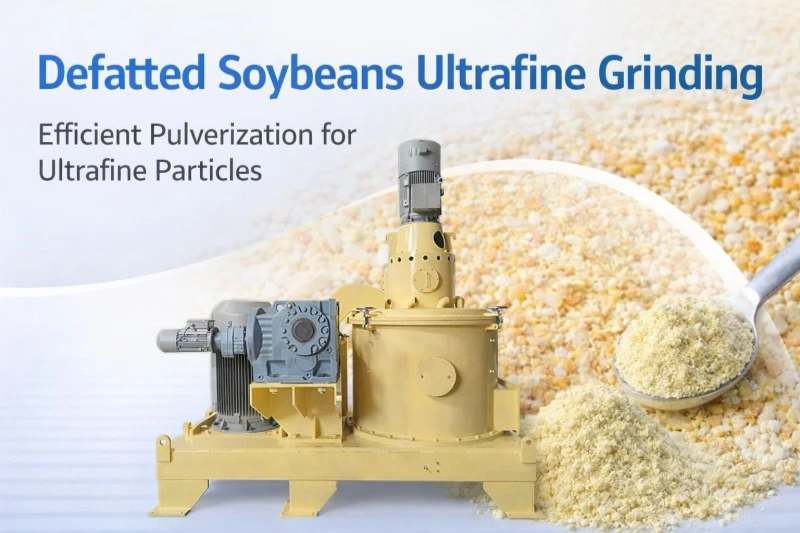
Ultrafine grinding of defatted soybeans at low temperature isn’t just about getting a finer powder—it’s about unlocking better function and quality for plant-based protein. Here’s what you get with a low-temperature air classifier mill:
Enhanced Solubility & Dispersion
- Higher Nitrogen Solubility Index (NSI): Low-temp grinding keeps protein structure intact, so more protein stays soluble.
- Smooth mixing: Ultrafine, uniform particles dissolve quickly in water or milk, making them ideal for beverages and high-protein foods.
- No clumps: The fine D50 60μm size means powders blend fast and stay smooth.
| Feature | Standard Pin Mill | Air Classifier Mill (Low-temp) |
|---|---|---|
| Solubility | Medium | High |
| Dispersion | Uneven | Uniform |
| Particle Size (D50) | 80-100μm | 60μm or finer |
Improved Mouthfeel
- No grittiness: Finer soybean particles mean a creamier, silkier texture in drinks, yogurts, and protein shakes.
- Better sensory experience: The mouthfeel is closer to dairy, which helps in plant-based innovation.
Higher Yield & Efficiency
- Less Protein Denaturation: Low grinding temperatures protect protein quality, so you get more functional soy protein isolate.
- Boosted extraction rates: More protein extracted per batch, thanks to higher solubility and less heat damage.
- Reduced waste: Efficient micronization means less product loss during processing.
Want to see how ultrafine grinding works for other plant proteins? Check out the health benefits and innovations in ultrafine processing of pea protein powder for more insight.
This is why low-temperature ultrafine grinding is the go-to for modern soy protein isolate processing—especially if you want top-quality defatted soy flour or 200 mesh soy powder.
Step-by-Step Process: The Epic Powder Air Classifier Mill Solution
Grinding defatted soybeans without heat damage is all about control and precision. Here’s how the Epic Powder Air Classifier Mill makes it happen, step by step:
Controlled Feeding
First, soybeans are fed into the mill at a steady, controlled rate. This keeps the grinding consistent and prevents overload. Controlled feeding is key for even particle size and helps avoid hot spots that can cause protein denaturation.
Impact Grinding & Airflow Cooling
Next, the soybeans enter the impact grinding zone. Here, high-speed rotors break down the beans into ultrafine particles. At the same time, strong airflow cools the product instantly. This dual action is what keeps the temperature low, protecting the Nitrogen Solubility Index (NSI) and ensuring no burnt flavors. The system acts as a low-temperature pulverizer, a big advantage over standard pin mills.
Dynamic Classification
After grinding, the air classifier steps in. It separates particles by size, sending only the right-sized powder forward. Anything too coarse gets sent back for another round. This dynamic classification is how you get that precise D50 60μm particle size distribution—ideal for soy protein isolate processing and defatted soy flour production.
Pneumatic Conveying & Separation
Finally, pneumatic conveyors move the finished soy powder to collection, keeping everything sealed and food-grade. This step also helps cool the powder further and prevents any clumping, a must for high-quality plant-based protein milling.
If you want a closer look at how this works in real-world applications, check out how air classifier mills deliver precise, food-grade grinding for corn flour and why air classifier mills are the top choice for ultrafine grinding of defatted soybean in large-scale production.
With this step-by-step process, you get micronized soybean meal with zero heat damage, consistent quality, and the efficiency global customers expect.
Practical Results: What to Expect from Defatted Soybeans Ultrafine Grinding
When you use an air classifier mill for defatted soybeans ultrafine grinding, here’s what you can expect in real-world results. Let’s break it down:
Particle Size Precision
- Consistent D50 at 60μm: Achieve tight control over particle size distribution, hitting the sweet spot for defatted soy flour and soy protein isolate processing.
- Uniformity matters: No more clumps or uneven textures—just smooth, food-grade powder ready for further processing or direct use.
Temperature Preservation
- Low-heat grinding: The airflow cooling in the mill keeps temperatures low, preventing protein denaturation and preserving the Nitrogen Solubility Index (NSI).
- No burnt flavors: Unlike standard pin mills, which can overheat and damage the product, the air classifier mill ensures the natural taste and nutrition stay intact.
- Cryogenic grinding alternative: You get similar results to cryogenic grinding, but without the added cost and complexity.
Equipment Stability
- Reliable operation: The system’s pneumatic conveying and separation reduce wear and tear, keeping maintenance low and uptime high.
- Stable performance: Whether you’re running soy protein, pea protein, or other plant-based powders, the air classifier mill handles it all with consistent results.
For a deeper dive into plant protein processing and how ultrafine grinding impacts quality, check out this guide on soy protein powder processing.
In short, you get precise, stable, and cool grinding—exactly what you need for high-value, food-grade defatted soy flour and protein powders.

“Thanks for reading. I hope my article helps. Please leave a comment down below. You may also contact Zelda online customer representative for any further inquiries.”
— Posted by Emily Chen