.webp)
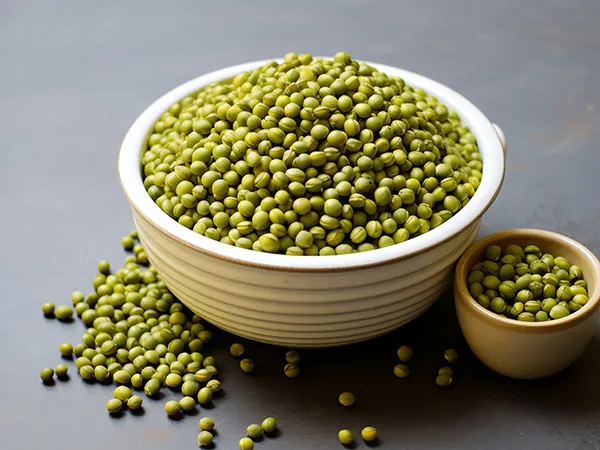
Defatted soybean, as a high-protein and low-fat plant-based raw material, is widely used in the food industry. With the growing consumer demand for healthy foods, ultrafine pulverization technology for defatted soybean has become a critical processing step. Market demand is mainly concentrated in the areas of meal replacement powders, baking auxiliaries, and pre-treatment for soy protein isolate (SPI).
The core objectives of pulverization are precise control of particle size distribution (PSD), preservation of protein activity, and achievement of a smooth, delicate mouthfeel. Too coarse particles affect product uniformity and sensory experience, while high-temperature pulverization may cause protein denaturation and reduce nutritional value.
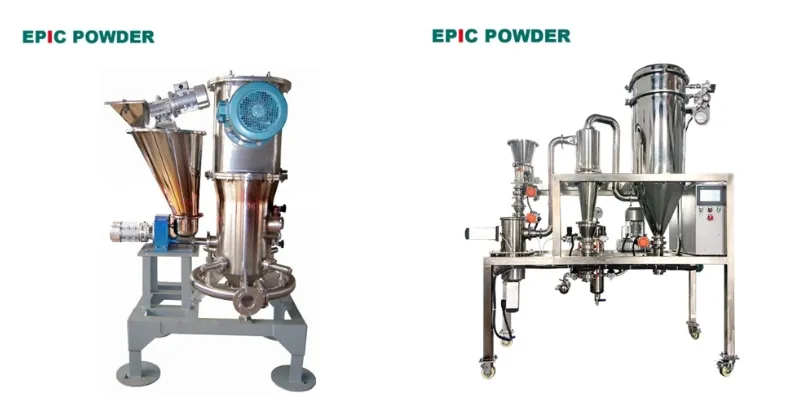
This article compares two mainstream ultrafine pulverization technologies: Jet Mill (fluidized bed opposed jet mill) and Air Classifier Mill (ACM). The Jet Mill is a media-free self-grinding equipment that uses high-velocity airflow to drive particle-to-particle collisions. The ACM is a mechanical impact mill equipped with an integrated classifier. Both have distinct advantages in defatted soybean processing, and this article provides an in-depth comparison across multiple dimensions.

Technical Principle Comparison
Jet Mill: Operates on the principle of supersonic airflow causing high-energy particle collisions (material self-grinding). Compressed air is accelerated through nozzles to supersonic speeds, forming high-velocity jets into which defatted soybean particles are injected. Particles collide, rub, and fracture with each other in the airflow without any external grinding media. This contact-free method is particularly suitable for heat-sensitive materials such as high-protein defatted soybean.
Air Classifier Mill (ACM): Uses mechanical impact principles — high-speed rotating hammers or blades strike the material against a fixed liner plate. Material enters the grinding chamber, is accelerated by the rotor, impacts the liner, and is simultaneously classified by an internal classifier wheel using centrifugal force to separate fine particles. The ACM combines mechanical force with air classification and is suitable for medium-fineness industrial grinding, though it may introduce some heat.
The fundamental difference in principles determines their suitability for defatted soybean: Jet Mills emphasize heat-free self-grinding, while ACMs focus on efficient mechanical size reduction.
In-depth Performance Comparison for Defatted Soybean Pulverization
Significant differences exist between Jet Mills and ACMs across multiple performance indicators in ultrafine grinding of defatted soybean. The table below provides a clear side-by-side comparison:
| Dimension | Jet Mill (Jet Mill) | Air Classifier Mill (ACM) |
|---|---|---|
| Final fineness (D₅₀) | Extremely fine: 1–5 μm, meets ultra-premium mouthfeel requirements | Medium fine: typically 15–40 μm, meets most food-grade needs |
| Temperature rise control | Excellent: adiabatic expansion cooling, completely prevents protein thermal denaturation | Good: large airflow removes heat, but slight temperature rise occurs during long runs |
| Particle size distribution | Extremely narrow: very high classification precision, virtually no oversize particles | Narrow: built-in classifier wheel gives uniform distribution but slightly inferior to Jet Mill |
| Production capacity | Lower: high specific energy consumption, suited for high-value, small-to-medium batches | High: large capacity (up to several tons/hour), ideal for industrial-scale production |
| Fat/moisture tolerance | Very low fat tolerance — residual fat easily clogs nozzles | Stronger tolerance — more forgiving to trace residual fat |
As shown, Jet Mills excel in fineness and temperature control, but have lower throughput; ACMs offer higher capacity and better material tolerance. For defatted soybean (which usually contains trace residual fat), ACM’s greater tolerance makes it more practical in many pre-treatment scenarios.
Impact on Protein Properties
The pulverization process directly affects key protein characteristics of defatted soybean, including solubility, sensory properties, and functionality.
Solubility (NSI/PDI) Jet Mills have a clear advantage. Their ultra-low temperature environment (due to adiabatic expansion cooling) causes minimal damage to soy protein structure, preserving higher solubility indices. In contrast, although ACMs use air cooling, mechanical impacts can still cause localized heat buildup, slightly reducing protein solubility.
Sensory Properties Powder produced by Jet Mills has a particle size closer to the human tongue’s tactile threshold (≈10 μm), effectively eliminating the “gritty” and “beany” off-notes common in soy flour. This is especially important for meal replacements and infant foods, where mouthfeel directly influences consumer acceptance. ACM products are uniform but may retain a slight coarse sensation due to their medium-fine size range.
Functionality The two methods differ in their modification effect on soy dietary fiber. The high-energy collisions in Jet Mills better open fiber structures, improving water-binding and emulsification properties — ideal for high-functionality protein applications. ACM’s mechanical impact provides good overall uniformity but less profound structural modification.
Overall, Jet Mills are superior for preserving protein integrity and are preferred for premium applications.
Cost and Operational Analysis
Energy consumption Jet Mills rely on large volumes of compressed air; their energy cost is typically 2–4 times higher than ACMs (mainly due to the required high-power air compressor). This makes Jet Mills more suitable for small-to-medium batch, high-value production rather than continuous large-scale operation.
Maintenance complexity Jet Mills have almost no moving parts (except the classifier wheel), resulting in simple structure and low maintenance — usually limited to periodic nozzle cleaning. ACMs require regular replacement of worn hammers and liners, leading to higher maintenance frequency, though the system is still relatively easy to manage.
Initial investment For the same throughput, a Jet Mill system (including compressor and auxiliaries) usually costs significantly more than an ACM due to stricter requirements on the air supply system. In the long run, ACMs generally offer better cost-effectiveness, especially at industrial scale.
Equipment Selection Recommendations: Which One Should I Choose?
Selection should be driven primarily by end-product positioning and production goals.
Scenario A: Choose Air Classifier Mill (ACM) Target products: commercial-grade soy milk powder, baking ingredients, etc. Goal: scale economy and cost-effectiveness (target D₉₀ ≈ 45 μm / 325 mesh). → ACM is the optimal choice due to its high capacity, lower operating cost, and good material tolerance.
Scenario B: Choose Jet Mill Target products: high-protein concentrates, pharmaceutical carriers, premium infant nutritional supplements, ultra-fine protein powders (<10 μm). Goal: extreme mouthfeel requirements or maximum retention of protein functionality. → Jet Mill is the better choice due to its superior fineness and near-zero thermal impact.
It is strongly recommended to conduct small-scale trials with your specific soybean feedstock to verify equipment compatibility.
Conclusion
Selection of ultrafine pulverization equipment for defatted soybean should be guided first and foremost by the positioning of the final product. Jet Mills are ideal for applications demanding the highest fineness and protein quality preservation, while ACMs excel in cost-efficiency and large-scale production.
Looking ahead, a hybrid process — coarse grinding with ACM followed by fine grinding with Jet Mill — is emerging as a promising trend. This combination effectively balances cost and particle size requirements and is likely to become a mainstream approach in the defatted soybean processing industry, driving it toward greater efficiency and refinement.

“Thanks for reading. I hope my article helps. Please leave a comment down below. You may also contact Zelda online customer representative for any further inquiries.”
— Posted by Emily Chen