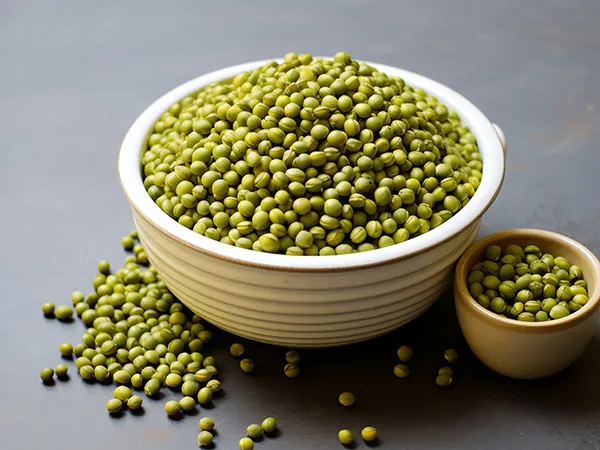
Defatted soybean meal, obtained after low-temperature desolventizing, is a key raw material for producing ultrafine soybean flour, high-protein concentrates, and functional proteins. Ultrafine grinding of defatted soybean (typically D50 < 20–50 μm, or even finer) significantly improves solubility, dispersibility, emulsification, and nutrient bioavailability, making it widely used in plant-based meat products, protein beverages, baked foods, and nutritional supplements.
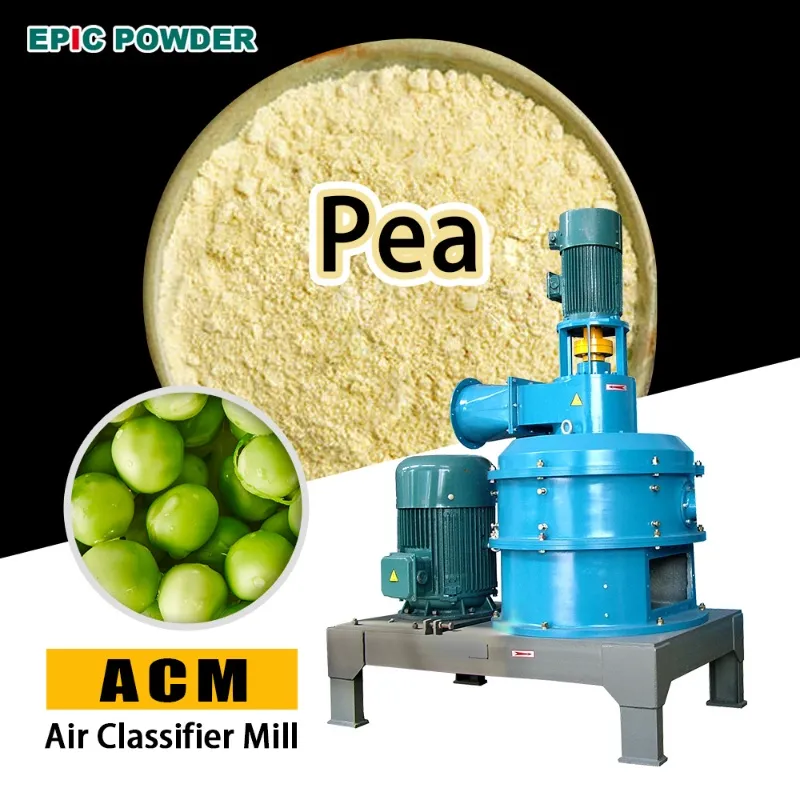
In large-scale production, common ultrafine grinding equipment includes jet mills, mechanical impact mills, and air classifier mills (ACM). Among them, the air classifier mill stands out as the best cost-performance solution for defatted soybean ultrafine grinding.

Working Principle and Features of the Air Classifier Mill
An air classifier mill is an integrated system that combines mechanical impact grinding and dynamic air classification:
- Grinding zone: High-speed rotating hammers or pin discs apply impact, shear, and friction to efficiently break down the material.
- Classification zone: A built-in turbine classifier wheel precisely controls the cut size by adjusting rotor speed and airflow. Coarse particles automatically return to the grinding zone, while fine particles are discharged.
- Closed-circuit operation: Oversized particles continuously recirculate until they meet the target size, ensuring a narrow particle size distribution.
Typical product fineness:
- D97 < 30–50 μm, adjustable to ultrafine grades (D50 ≈ 10–20 μm).
Comparison with Other Grinding Technologies
| Item | Air Classifier Mill (ACM) | Jet Mill | Traditional Mechanical Mill (Hammer / Ball Mill) |
|---|---|---|---|
| Grinding principle | Mechanical impact + internal dynamic classification | High-velocity particle-to-particle collision (no media) | Pure mechanical friction / impact |
| Particle size control | Precise, adjustable, narrow distribution | Extremely fine and uniform, requires external classification | Wide distribution, prone to over-grinding |
| Throughput | High (several tons per hour per unit) | Medium (often requires multiple units in parallel) | High, but limited fineness |
| Energy consumption | Medium (30–50% lower than jet mill) | High (compressed air intensive) | Low, but high heat generation |
| Temperature rise | Controllable (air-assisted cooling) | Very low (expansion cooling) | High (risk of protein denaturation) |
| Contamination risk | Low (wear-resistant liners) | Minimal (no mechanical contact) | High (media and liner wear) |
| Maintenance cost | Moderate | Low | High |
| Suitable scale | Large-scale continuous production | Small to medium scale, high purity | Coarse grinding or small-scale use |
Advantages of Air Classifier Mills in Large-Scale Ultrafine Grinding of Defatted Soybean
High Throughput and Efficiency
Defatted soybean meal has low stickiness and moderate hardness, making it ideal for ACM processing. A single ACM unit can achieve several tons per hour, suitable for tens-of-thousands-of-tons annual production lines. The closed-circuit design eliminates the need for external classifiers, simplifying the process and ensuring stable output.
Outstanding Cost-Effectiveness
Compared with jet mills, ACMs consume significantly less energy because they do not rely on large volumes of compressed air. Capital investment and operating costs are reduced by 30–50%, resulting in a shorter payback period and the lowest total cost of ownership (TCO) in large-scale operations.
Precise Particle Size Control
The built-in classifier wheel ensures a narrow particle size distribution, preventing over-grinding and preserving protein functionality (such as solubility and emulsification). Studies show that ACM-processed ultrafine soybean flour exhibits significantly better water-holding capacity and gel strength in plant-based meat applications than conventionally milled powders.
Low-Temperature Processing Protects Nutrients
Air-assisted cooling keeps temperature rise under control, avoiding thermal denaturation of soybean proteins. This makes ACMs ideal for producing high-NSI (Nitrogen Solubility Index) ultrafine powders, especially for dry protein enrichment processes.
Compatibility with Dry Fractionation Processes
In dry soybean protein concentration, ACMs are often used for pre-grinding followed by air classification, enabling effective separation of protein from fiber and starch. Protein enrichment levels above 60% can be achieved, with a solvent-free and wastewater-free process.
Durable and Easy to Maintain
Given the mild abrasiveness of soybean materials, ACMs equipped with wear-resistant liners offer reliable continuous operation and simplified maintenance.
Practical Benefits in Industrial Applications
- Improved product quality: Ultrafine soybean flour has a larger specific surface area, increasing dissolution rates by 20–50%. It disperses better in protein beverages and delivers more meat-like texture and chewiness in plant-based meat products.
- Economic benefits: Large-scale production lines using ACMs can reduce processing costs per ton by 15–30%, while accessing higher-value markets for functional protein products.
- Environmental sustainability: Predominantly dry processing with no chemical reagents, aligning with green and clean-label food trends.
Conclusion
In large-scale production, the air classifier mill offers the optimal balance of high throughput, low energy consumption, precise particle size control, and overall low cost, making it the most cost-effective solution for ultrafine grinding of defatted soybean. It successfully balances efficiency, quality, and economics, and is especially suitable for industrial protein powder production lines with annual capacities in the tens of thousands of tons.
Compared with the high-precision but energy-intensive jet mill and the coarse and less efficient traditional mills, the air classifier mill stands out as the industrial-scale first choice.
For specific equipment selection or production line design, feel free to consult Epic Powder, your professional partner in advanced powder processing solutions.

“Thanks for reading. I hope my article helps. Please leave a comment down below. You may also contact Zelda online customer representative for any further inquiries.”
— Posted by Emily Chen