Why Ultrafine Grinding is Critical for Konjac Quality
When it comes to konjac flour manufacturing, ultrafine grinding is a game changer. The quality of konjac powder largely depends on how finely it is milled, as particle size directly influences its solubility and functional properties.
Particle Size vs. Solubility
- Smaller particle size means better glucomannan extraction and faster dissolution in water.
- Ultrafine konjac powder rapidly hydrates, delivering superior gel strength and smoother texture.
- Proper particle size distribution (PSD) avoids clumping and improves product consistency.
Viscosity Preservation
- Maintaining the natural konjac gum viscosity is essential for food-grade applications.
- Overheating during grinding can degrade viscosity; ultrafine grinding with temperature control keeps the thickening power intact.
Impurity Separation
- Ultrafine grinding helps efficiently separate fibrous materials and impurities from pure konjac powder.
- This enhances purity and overall quality, crucial for sensitive food and pharmaceutical products.
In , ultrafine grinding is not just about size—it’s about preserving the konjac’s functional benefits, ensuring consistent viscosity, and optimizing solubility for better end-use performance. Using advanced milling techniques like the air classifier mill for food ensures these goals are met with precision.

The Technology: Air Classifier Mills (ACM) in Konjac Processing
When it comes to ultrafine grinding in konjac flour manufacturing, air classifier mills (ACM) stand out as the top choice. Why ACM? Because they deliver precise particle size distribution (PSD), essential for producing consistent 80 mesh powder that maintains konjac gum viscosity and solubility.
Why ACM?
Air classifier mills are designed specifically for heat-sensitive material grinding like konjac. Unlike traditional industrial pulverizer machines, ACMs use air flow to classify and separate particles. This means the final konjac powder achieves ultrafine, uniform particle sizes without overheating or damaging the glucomannan extraction process.
Mechanism of Action
The action of an ACM involves feeding raw konjac flour into a grinding chamber where high-speed rotors break down fibrous material. Then, an integrated powder classifying system separates particles by size via centrifugal force and airflow. Finer particles are carried by the air stream and collected, while larger ones are cycled back for regrinding until the desired ultrafine 80 mesh standard is met.
Temperature Control
Maintaining low-temperature grinding is crucial. Heat from friction can degrade konjac gum viscosity, reducing quality. The airflow in air classifier mills not only classifies but also cools the material during grinding. This dust-free operation preserves glucomannan’s functional properties, making ACM a food grade grinding mill ideal for konjac flying powder removal and overall yield efficiency.
For more on how ACMs refine food powders without losing quality, check out the high efficiency food-grade grinding solutions using Epic Powder air classifier mills for precise corn flour processing.
By combining precise ultrafine grinding with excellent temperature control, ACMs ensure your konjac powder stays top-notch for any application.
Technical Parameters: Achieving the Right Mesh for Konjac Ultrafine Grinding
When it comes to konjac ultrafine grinding, achieving the right mesh size is crucial to ensure optimal product quality. The 80 mesh powder production standard is widely accepted in the industry, balancing particle size distribution (PSD) and solubility.
Why 80 Mesh?
- Optimal solubility: Particles passing through 80 mesh screens dissolve evenly without clumping.
- Consistent viscosity: Maintains the konjac gum viscosity essential for food and pharmaceutical applications.
- Efficient impurity separation: Fine grinding helps separate fibrous materials effectively.
Beyond 80 Mesh: Flexibility & Adjustability
Some applications may require powders finer than 80 mesh, such as micronized konjac flour. The key is adjustability in the grinding process:
| Parameter | Typical Range | Effect |
|---|---|---|
| Mesh size | 80 mesh to 200 mesh | Finer powder improves dissolution time |
| Airflow speed | Adjustable (low to high) | Controls particle size in air classifier mills |
| Classifier wheel RPM | Variable | Determines separation efficiency |
| Grinding temperature | <50°C (Low-temperature) | Protects heat-sensitive konjac gum |
By controlling these parameters, especially in an air classifier mill for food processing, producers can tune the konjac powder to specific customer requirements while preserving quality.
For a deeper dive on how air classifier mills achieve consistent micronization with efficient powder classifying systems, you can explore related Ultrafine Grinding techniques used in starch processing here.
Fine-tuning these parameters ensures that konjac flour manufacturing stays efficient and scalable, delivering powders that meet strict food-grade standards.
The Epic Powder Advantage: Customized Solutions, Dust-Free Operation, Yield Efficiency
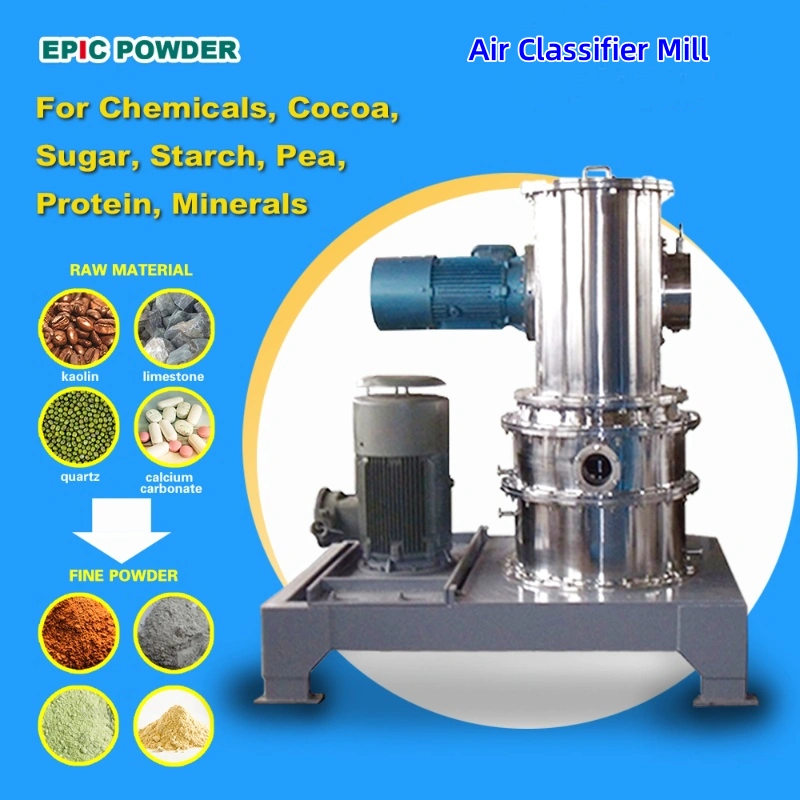
When it comes to konjac ultrafine grinding, Epic Powder stands out by offering customized solutions tailored to meet the unique demands of konjac flour manufacturing. We understand the importance of maintaining the konjac gum viscosity and achieving a consistent particle size distribution (PSD), which is why our air classifier mill systems are designed specifically for fibrous material milling like konjac.
Our equipment supports dust-free operation, a critical feature for food grade grinding mills, ensuring a cleaner workspace and reducing product loss from konjac flying powder removal. This not only protects your workers but also maximizes product yield.
Thanks to advanced micronization equipment and precise powder classifying systems, Epic Powder’s solutions deliver high yield efficiency in producing uniform 80 mesh powder. By controlling factors such as low-temperature grinding and optimizing the particle size, we help preserve the heat-sensitive qualities of konjac, essential for its solubility and viscosity.
For additional insights on ultrafine powder processing, exploring our processing technology and application of fruit and vegetable powder page might provide useful parallels in low-temperature grinding and industrial pulverizer machine applications.
Common Questions on Konjac Grinding (Q&A): Air Classifier Mill vs Jet Mill & Ensuring Uniform 80 Mesh Powder
.webp)
Q1: What’s the difference between an Air Classifier Mill and a Jet Mill for konjac ultrafine grinding?
Air Classifier Mills (ACM) use a built-in classifier wheel to separate and control particle size during grinding. This means you get uniform particles, typically hitting the essential 80 mesh powder standard for konjac flour manufacturing, while preserving konjac gum viscosity and preventing overheating. Jet Mills rely on high-speed air jets to pulverize and classify simultaneously but can generate more heat, which risks affecting heat-sensitive materials like konjac powder. For large-scale, food-grade grinding of konjac ultrafine powder, ACMs offer better temperature control and yield efficiency, making them a preferred choice. For in-depth understanding of how air classifier mills create the perfect particle size, you can check detailed insights about how Air Classifier Mills achieve ultrafine black soybean powder size.
Q2: How can I ensure a uniform 80 mesh powder when grinding konjac?
Achieving consistent 80 mesh powder production requires precise control of grinding speed, classifier wheel speed, and feed rate in your grinding system. Using an air classifier mill specifically designed for fibrous material milling like konjac ensures uniform particle size distribution (PSD) without overheating or damaging the gluco-mannan extraction process. Additionally, low-temperature grinding helps maintain konjac gum viscosity and removes flying powder efficiently. The ability to adjust technical parameters on an ACM allows you to fine-tune the output mesh size exactly. If you want to explore further benefits of air classifying mills for ultra-fine and consistent powder production, the article on why ACMs are superior for soy protein isolate grinding provides relevant strategies applicable to konjac as well.
These answers should help you confidently choose and operate grinding mills for consistent, high-quality konjac flour manufacturing with guaranteed 80 mesh powder standard.

“Thanks for reading. I hope my article helps. Please leave a comment down below. You may also contact Zelda online customer representative for any further inquiries.”
— Posted by Emily Chen