With the rapid growth of plant-based proteins, functional foods, and premium instant powder products, ultrafine black soybean powder—with D90 ≤ 10 μm or even D98 ≤ 8 μm—has become a key differentiation point for many brands. To produce this level of fineness stably, efficiently, and cost-effectively, the Air Classifier Mill (ACM) has emerged as the most mainstream and best overall-value solution available today.

Why Is Ultrafine Grinding of Black Soybeans So Difficult?
Black soybeans are particularly challenging to grind due to a combination of intrinsic material properties:
- High oil content (≈15–20%) → prone to stickiness and agglomeration
- High protein content (≈35–40%) → proteins denature easily under heat, increasing viscosity
- High fiber content (especially seed coat) → tough and difficult to shear
- Strong hygroscopicity → rapidly absorbs moisture and cakes once temperature rises or exposure time increases
When pushed to ultrafine sizes, these factors often lead to:
- Severe material build-up on internal surfaces
- Sharp drops in throughput
- Sudden widening of particle size distribution (excessive fines + coarse tails)
- Darkened color and degraded flavor
The Air Classifier Mill stands out as the most balanced solution for addressing all of these pain points simultaneously.
Core Mechanisms by Which ACM Achieves the “Perfect” Ultrafine Particle Size
Modern ACM systems achieve stable production of black soybean powder with D90 ≤ 8–12 μm through coordinated design and precise control of several key elements:
1. High-Speed Impact + Intense Shear Composite Grinding Zone
The rotor tip speed typically reaches 110–160 m/s (up to 200 m/s in advanced designs), generating strong impact, shear, and aerodynamic tearing forces that effectively break down tough fibrous structures in black soybeans.
2. Integrated High-Precision Classifier Wheel (The “Heart” of the ACM)
By adjusting the classifier wheel speed (typically 3,000–12,000 rpm), the balance between centrifugal force and inward airflow drag is precisely controlled. This determines which particles are discharged and which are returned for further grinding.
Typical control logic (black soybean example):
- For finer particles → increase classifier speed + slightly reduce airflow
- For narrower PSD → increase classifier speed + fine-tune secondary airflow
3. Precise Temperature Control System (Often the Deciding Factor)
| Location | Target Temperature | Purpose |
|---|---|---|
| Inlet air | –10°C to 5°C | Minimize material temperature rise |
| Average mill chamber | 35–48°C | Prevent protein denaturation and oil exudation |
| Outlet / product | ≤52°C (preferably ≤48°C) | Preserve flavor and solubility |
| Classifier bearing zone | ≤65°C | Protect high-speed precision bearings |
Advanced systems typically combine:
- Chiller-supplied cold air
- Jacket cooling of the mill body
- Forced water or oil cooling of the classifier shaft
4. Multi-Level Airflow Distribution & Anti-Build-Up Design
- Bottom secondary airflow (fluidizing air) to eliminate dead zones
- Special ceramic liners, advanced coatings, or air curtain protection inside the chamber
- Angled feeding with pneumatic dispersion to prevent lump formation
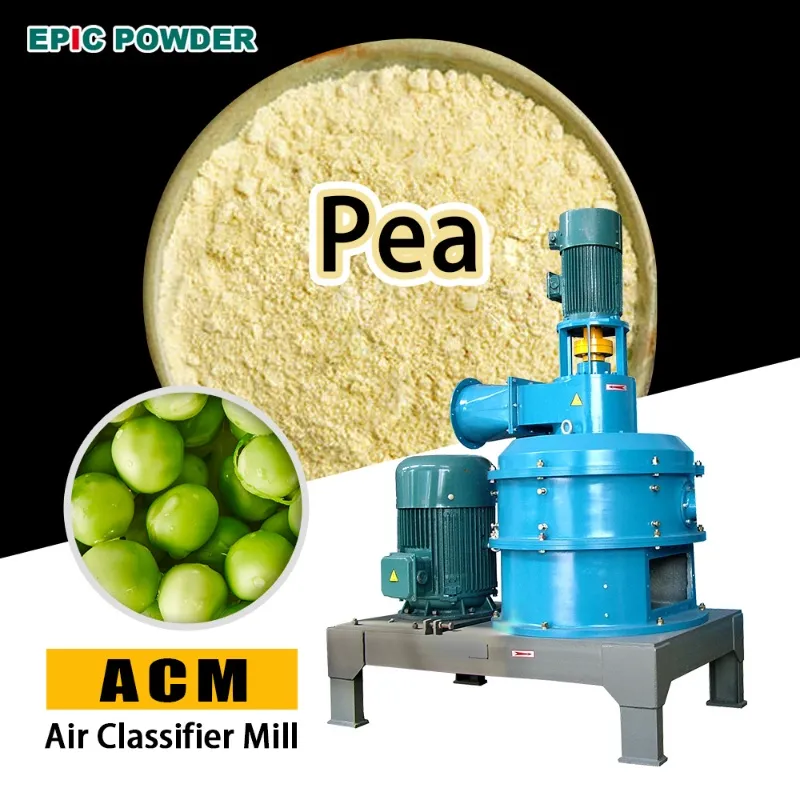
Typical Industrial Operating Parameters (Fully Dehulled Black Soybeans)
Target: D98 ≤ 10 μm, D90 ≈ 7.5–8.5 μm, minimal protein denaturation
| Parameter | Typical Range | Recommended “Sweet Spot” | Notes |
|---|---|---|---|
| Main motor speed | 3,000–7,500 rpm | 4,800–6,200 rpm | Depends on mill size |
| Classifier speed | 4,000–11,000 rpm | 7,200–9,600 rpm | Most sensitive parameter |
| System airflow | 3,000–12,000 m³/h | Matched to mill | Higher airflow → coarser product |
| Feed rate | 80–400 kg/h | 120–220 kg/h | Too fast → coarse; too slow → overheating |
| Mill negative pressure | –150 to –400 mmH₂O | –220 to –320 mmH₂O | Affects residence time |
| Inlet air temperature | –5 to 8°C | –2 to 3°C | Lower helps fineness but raises energy cost |
One-Sentence Summary: The “Perfect Particle Size” Formula for Ultrafine Black Soybean Powder
“Low temperature + strong impact + ultra-high-speed classifier wheel + precisely coordinated secondary airflow”
is currently the most mature, stable, and energy-efficient industrial route for producing D90 ≤ 8 μm ultrafine black soybean powder.
Possible Next-Generation Breakthroughs
- Cryogenic or liquid-nitrogen-assisted grinding combined with ACM
- AI-driven adaptive control linking classifier speed and feed rate
- Full ceramic linings and oil-free high-speed bearings to further reduce metal contamination and heat generation
However, within the 2025–2027 time window, for most manufacturers with commercial-scale demand, a well-optimized, high-spec Air Classifier Mill—especially with enhanced cooling and high-speed classification—remains the most practical, economical, and reliable “perfect particle size” solution.

“Thanks for reading. I hope my article helps. Please leave a comment down below. You may also contact Zelda online customer representative for any further inquiries.”
— Posted by Emily Chen