
Starch is an important raw material for both food and industrial applications. It is widely used in pharmaceuticals, food processing, textiles, and other fields. With continuous technological advancement, requirements for starch particle fineness are becoming increasingly stringent. This trend has led to the rapid development of ultrafine grinding technology. Ultrafine grinding reduces materials to the micrometer or even nanometer scale. This process significantly improves starch solubility, flowability, and bioavailability. The air classifier mill (ACM) is a highly efficient ultrafine grinding device that integrates impact grinding and air classification. It enables efficient ultrafine grinding of starch by combining size reduction and precise particle classification in a single system. This article discusses how to achieve efficient starch ultrafine grinding using an ACM and analyzes its advantages and key application considerations.

Working Principle of the Air Classifier Mill
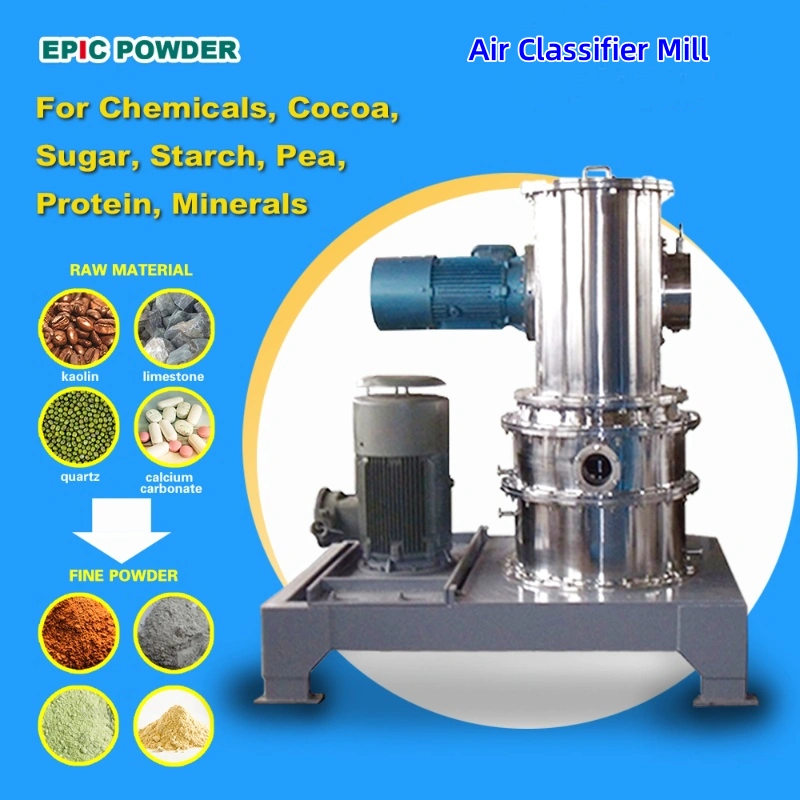
An air classifier mill is a mechanical device that integrates grinding and classification. Its core components include a rotor, hammers or pins, an air classifier wheel, and a collection system. During operation, starch is fed into the grinding chamber through the inlet. Driven by the high-speed rotating rotor, the material is subjected to strong impact and shear forces from the hammers or pins, resulting in primary size reduction.
At the same time, compressed air is introduced into the system to form a high-velocity airflow. This airflow further accelerates particle collisions and friction, promoting finer grinding.
The key classification process occurs at the air classifier wheel. Fine particles are carried upward by the airflow into the classification zone, where they pass through the classifier wheel and are collected as the final product. Coarse particles, under the combined effects of centrifugal force and gravity, are rejected and returned to the grinding chamber for further size reduction. This closed-circuit design ensures high grinding efficiency and uniform particle size distribution while avoiding over-grinding and unnecessary energy consumption.
For starch, which tends to be adhesive, the air-assisted system of the ACM also helps prevent material buildup and blockage, ensuring stable operation.
Application of Air Classifier Mills in Starch Ultrafine Grinding
Ultrafine grinding of starch is commonly applied to corn starch, cassava starch, and potato starch. When using an air classifier mill, the starch feed should be properly dried, with moisture content typically controlled below 10% to prevent agglomeration.
Equipment parameter settings are critical to performance:
- Rotor speed: Typically adjusted between 3,000 and 6,000 rpm. Higher speeds promote finer particles but excessive speed may generate heat and affect starch properties.
- Air pressure: Generally maintained between 0.5 and 1.0 MPa to ensure sufficient airflow for effective particle separation.
- Classifier wheel speed: Adjusted according to the target particle size, commonly aiming for a D50 of 5–20 μm.
- Feed rate: Controlled at less than 80% of the mill’s rated capacity to avoid overload.
For example, in corn starch processing, an ACM can reduce particle size from an initial 100–200 μm to below 10 μm while maintaining high throughput. In addition, combining pretreatment methods such as low-temperature drying or the use of grinding aids can further improve grinding efficiency. In practical operation, online monitoring systems can be used to adjust parameters in real time and enable continuous production.
Efficiency Advantages of Air Classifier Mills
Compared with traditional ball mills or vibration mills, air classifier mills offer significant advantages in starch ultrafine grinding:
- High efficiency: Integrated grinding and classification reduce the need for multiple processing stages, improving energy utilization by more than 30%.
- Uniform particle size: Air classification ensures a narrow particle size distribution, meeting the requirements of high-quality applications such as food additives.
- Low-temperature operation: The air cooling effect prevents starch gelatinization and helps preserve nutritional properties.
- Environmental friendliness: The enclosed system reduces dust emissions and complies with food safety standards.
- Versatility: Suitable for various types of starch and easily extended to other food powders, such as matcha and cereal powders.
Studies have shown that starch processed by air classifier mills can achieve a 20–50% improvement in solubility and absorption efficiency, indicating strong potential for pharmaceutical applications.
Operational Considerations and Case Studies
In practical applications, proper equipment maintenance is essential. The classifier wheel should be cleaned regularly to prevent starch buildup and blockage. Temperature monitoring is also critical, and operating temperatures should generally be kept below 60 °C to protect starch structure.
In one case, a food processing plant adopted an ACM to process corn starch. The system achieved a daily output of 5 tons, with particle size controlled at approximately 15 μm. Production efficiency increased by about 40% compared with conventional grinding methods.
In another example, ultrafine grinding of cassava starch was achieved using an air-based classifier mill, enabling the transformation from coarse powder to near-nanoscale particles for applications in biodegradable materials.
Conclusion
As an advanced grinding technology, the air classifier mill provides a reliable solution for the efficient ultrafine grinding of starch. Through optimized operating parameters and process design, it not only improves production efficiency but also enhances product quality. With ongoing advancements in intelligent equipment and process control, this technology is expected to play an increasingly important role in both food and industrial applications. Enterprises are advised to select appropriate mill models based on their specific requirements and to verify performance through pilot testing.

“Thanks for reading. I hope my article helps. Please leave a comment down below. You may also contact Zelda online customer representative for any further inquiries.”
— Posted by Emily Chen