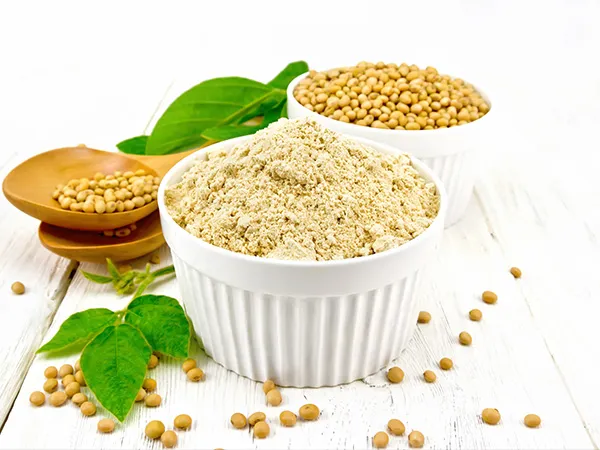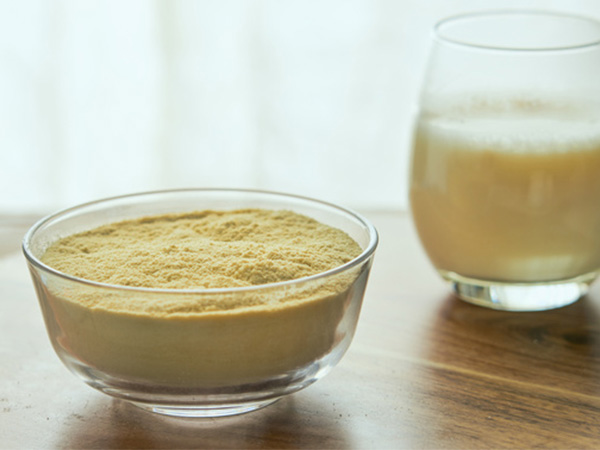
Soy protein isolate (SPI) is a highly refined plant-based protein product containing ≥90% protein on a dry basis. It is widely used in food applications such as meat analogs, nutritional beverages, infant formula, bakery products, and high-protein snacks due to its excellent emulsification, gelation, solubility, and nutritional profile (high PDCAAS score, complete amino acid profile). Producing high-quality soy protein isolate requires precise control during the grinding stage of defatted soy flour or meal. The goal is to achieve:
- Ultrafine particle size (typically D97 < 20–50 µm, often 10–30 µm for optimal functionality)
- Narrow particle size distribution (PSD) to ensure uniform dispersion and mouthfeel
- Minimal heat generation to preserve protein denaturation, solubility, and functional properties
- Low contamination and gentle processing for food-grade purity
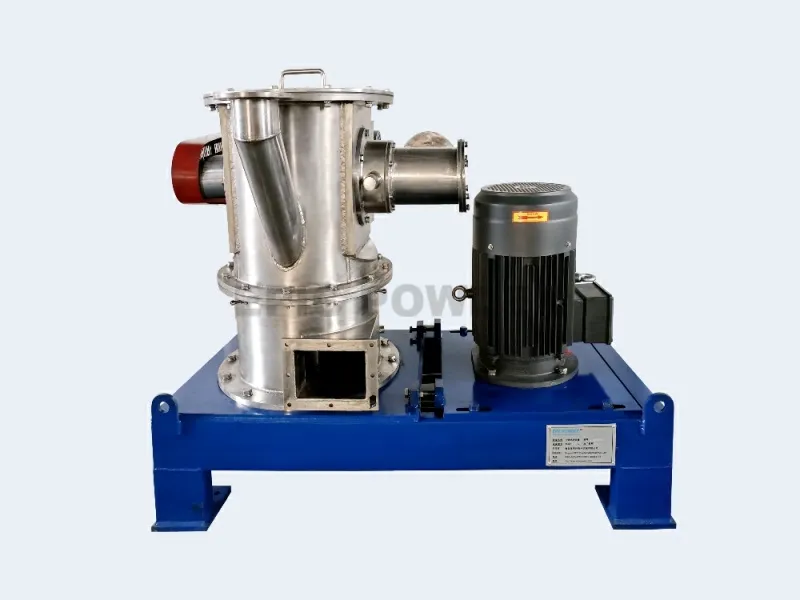
Among various milling technologies — hammer mills, pin mills, jet mills, roller mills, and others — Air Classifying Mills (ACM) stand out as particularly superior for SPI grinding. Here’s why.
Core Working Principle of ACM
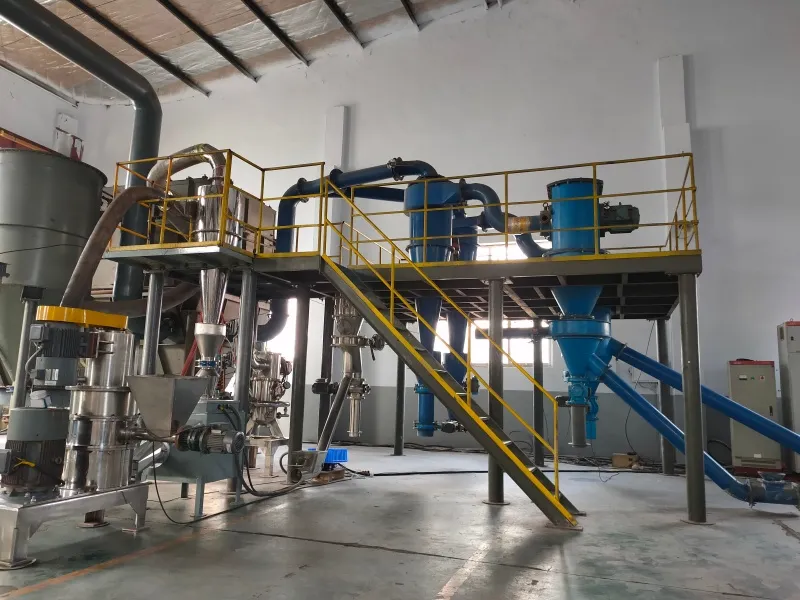
An ACM is an air-swept mechanical impact mill with an integrated dynamic air classifier. Key steps include:
- Material enters the grinding chamber and is impacted at high speed (beater tip speeds up to 120–140 m/s) by rotating pins/hammers against a serrated liner → size reduction via impact and attrition.
- Simultaneously, strong airflow (often 2,000–10,000 m³/h depending on scale) fluidizes and conveys particles to the classifier wheel (rotor) at the top.
- The classifier wheel separates fines (acceptable product) from oversize particles based on centrifugal vs. drag force balance.
- Oversize particles are rejected and returned immediately to the grinding zone for re-grinding → closed-loop recirculation until all particles meet the target size.
This “grind + classify in one machine” design is the key differentiator.
Why ACM Excels for Soy Protein Isolate Grinding
| Advantage | Explanation for SPI | Benefit Compared to Alternatives (e.g., Jet Mill, Hammer Mill) |
|---|---|---|
| Integrated Grinding & Classification | Achieves precise top-cut control (sharp PSD) in a single pass; recirculates coarse fractions automatically. | Jet mills lack internal mechanical impact → lower throughput; separate classifier often needed. Hammer/pin mills produce wider PSD without built-in sharp classification. |
| Excellent Heat Management for Heat-Sensitive Proteins | High-volume cooling/conveying air keeps product temperature <50–60°C even at fine sizes; prevents denaturation, Maillard reactions, or loss of solubility/Nitrogen Solubility Index (NSI). | Jet mills are cold but low throughput; mechanical mills without strong air cooling can heat up significantly. |
| High Throughput & Scalability | Processes tons/hour in industrial models; much higher capacity than jet mills for similar fineness. | Jet mills limited to lower feed rates due to gas energy requirements; ACM handles larger volumes efficiently. |
| Narrow & Controllable PSD | Adjustable classifier wheel speed (3,000–10,000+ rpm), airflow, and rotor design allow D90/D10 ratios of 2–3 or better; minimal oversize particles. | Critical for SPI dispersion, emulsion stability, and smooth texture in final products. Jet mills can achieve finer sizes but often broader tails without optimization. |
| Gentle on Protein Functionality | Impact + air turbulence is controlled; avoids excessive shear or over-grinding that damages protein structure. | Preserves emulsifying, foaming, and gelling properties better than aggressive mechanical mills. |
| Energy & Cost Efficiency | Lower specific energy consumption than pure jet milling for mid-to-fine ranges (D97 10–30 µm); one machine vs. mill + separate classifier. | Jet mills consume more compressed air/gas energy; ACM is more economical at production scale. |
| Versatility & Proven for Legumes | Widely used for soy, pea, lentil, and other pulse proteins; handles defatted soy meal effectively. | Hosokawa Mikro ACM® explicitly lists soy protein applications; ideal for protein shifting/enrichment in dry fractionation. |
| Low Maintenance & Food-Grade Design | Easy-access versions (e.g., Easy Access Mikro ACM) allow quick cleaning; stainless steel, FDA-compliant materials. | Minimal wear parts; suitable for frequent changeovers in food plants. |
Typical ACM Configuration for SPI
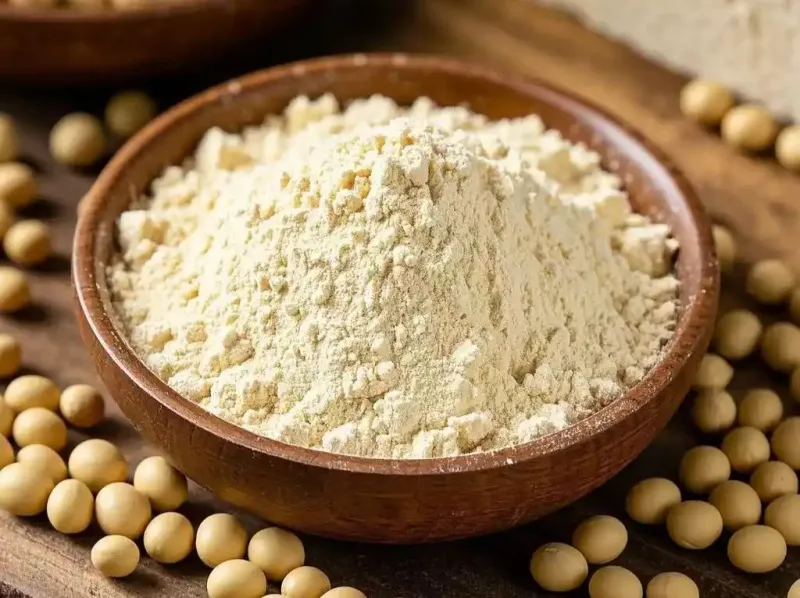
- Feed: Defatted soy flour/meal (pre-ground to ~100–500 µm)
- Target: D97 ≈ 15–40 µm, narrow PSD for high NSI (>80–90%) and functionality
- Options: Chilled air/inlet for extra heat-sensitive batches; ceramic/beater coatings for minimal metal pickup
- Downstream: Cyclone + bag filter collection; often followed by spray drying if starting from wet extraction
Comparison Summary: ACM vs. Common Alternatives for SPI
- vs. Jet Mill: ACM offers 5–10× higher throughput, better energy efficiency, and integrated sharp classification at the cost of slightly less ultra-fine capability (jet mill better below ~5–10 µm). For most SPI (10–30 µm), ACM is superior.
- vs. Pin/Hammer Mill + External Classifier: ACM combines both in one unit → simpler layout, lower footprint, better PSD control, less heat buildup.
- vs. Roller Mill: ACM achieves much finer sizes with narrower distribution; roller mills better for coarse pre-grinding only.
Conclusion
Air Classifying Mills (ACM) are superior for soy protein isolate grinding because they deliver the ideal combination of ultrafine size reduction, sharp particle size distribution, low-temperature processing, high throughput, and process simplicity — all critical for maintaining the functional, nutritional, and sensory qualities of SPI.
In modern plant-based protein production, where consistency, cost-efficiency, and protein functionality are paramount, the ACM remains a proven, versatile workhorse in soy and other legume protein applications. As demand for high-quality SPI continues to grow in meat alternatives and nutritional products, ACM technology will remain central to efficient, high-performance manufacturing.

“Thanks for reading. I hope my article helps. Please leave a comment down below. You may also contact Zelda online customer representative for any further inquiries.”
— Posted by Emily Chen