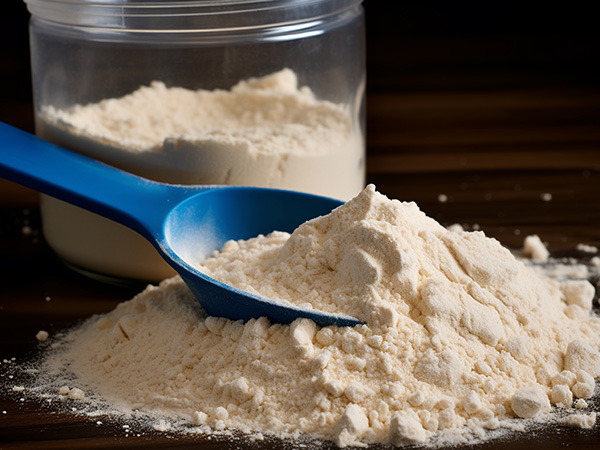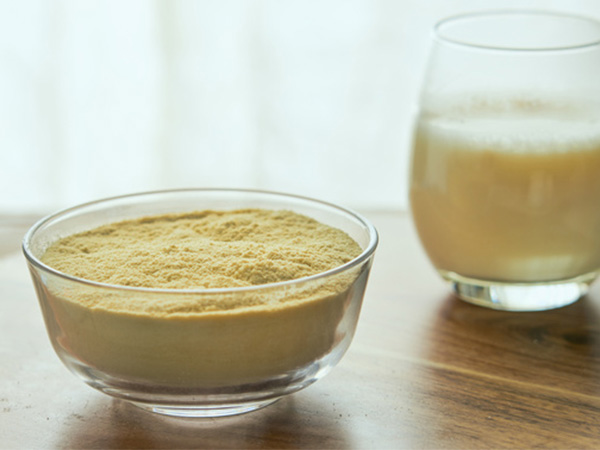
Potato starch is a fine, white powder extracted from potatoes. Unlike potato flour, which uses the whole potato, potato starch is pure starch isolated from the potato’s cells. This makes potato starch a neutral-tasting, versatile ingredient widely used in cooking and industry.
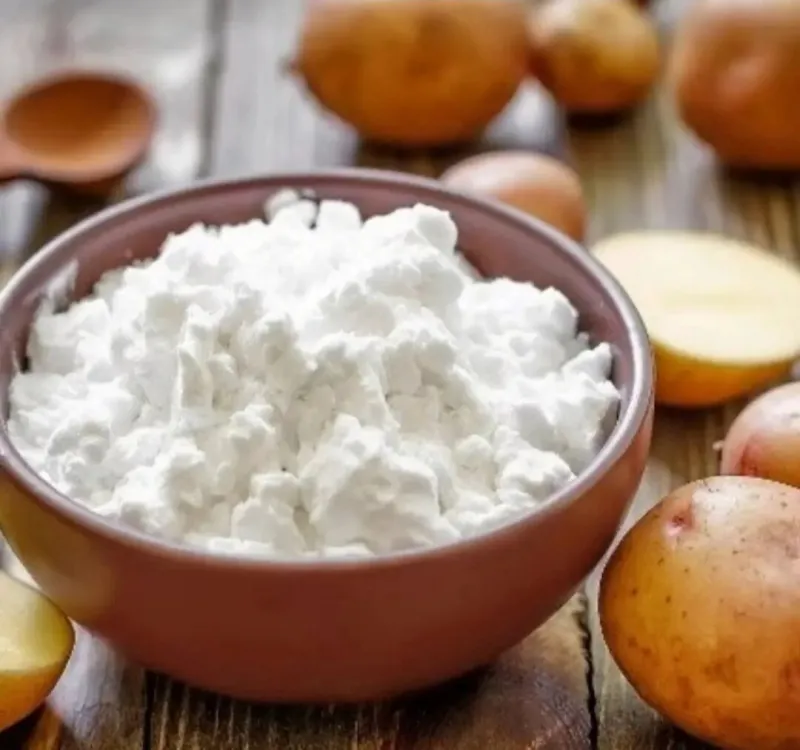
Key Characteristics of Potato Starch
| Feature | Description |
|---|---|
| Granule Size | Large, smooth, and uniform granules |
| Taste | Completely neutral, no strong potato flavor |
| Viscosity | High thickening power, creates glossy textures |
| Phosphate Content | Naturally high, which improves water retention and swelling |
Potato Starch vs. Potato Flour
| Aspect | Potato Starch | Potato Flour |
|---|---|---|
| Composition | Pure starch | Whole potato, including fiber and protein |
| Texture | Fine powder | Coarser, more fibrous |
| Taste | Neutral | Slightly earthy and potato-like |
| Culinary Use | Thickening, binding | Breads, coatings, and bulk |
Potato starch’s unique qualities make it ideal for thickening sauces, baking gluten-free foods, and creating crispy coatings—offering seamless versatility not matched by potato flour.
How Potato Starch Is Produced?
The production of high-quality potato starch follows a clear step-by-step process to ensure purity, yield, and particle size control. It begins with raw material selection, where high-starch potato varieties are chosen for maximum starch content. Next, the potatoes undergo thorough cleaning to remove dirt and impurities, preparing them for efficient processing.
The critical phase is grinding, where the potato cells are disrupted to release starch granules into a slurry. This step greatly influences the starch extraction yield and the quality of the final product. Proper grinding ensures a potato slurry preparation with optimal particle size, typically targeting a d97 around 100μm for premium applications.
Once ground, the slurry passes through separation stages to remove fibers and unwanted solids, followed by refining techniques such as centrifugal sieving and hydrocyclones to enhance starch purity. Afterwards, the starch undergoes dewatering, often via vacuum systems, to reduce moisture content before the final drying step, which stabilizes the starch powder for storage and transport.
Efficient grinding plays a pivotal role throughout—it’s the key to freeing intact starch granules while maintaining their structure for downstream processing. Selecting the right milling equipment, such as high-efficiency grinders and air classifier mills, can significantly improve starch liberation, yield, and particle uniformity.
For insights into achieving micronized starch particles using advanced grinding technology, see how an air classifier mill ensures ultra-fine grinding and precise particle size control.
Advanced Grinding Equipment for Potato Starch
For top-quality potato starch grinding preparation, using advanced equipment is key. High-efficiency potato rasping machines start the process by crushing the potatoes and forming a uniform slurry, which is essential for effective starch liberation.
Air Classifier Mills for Precise Fineness
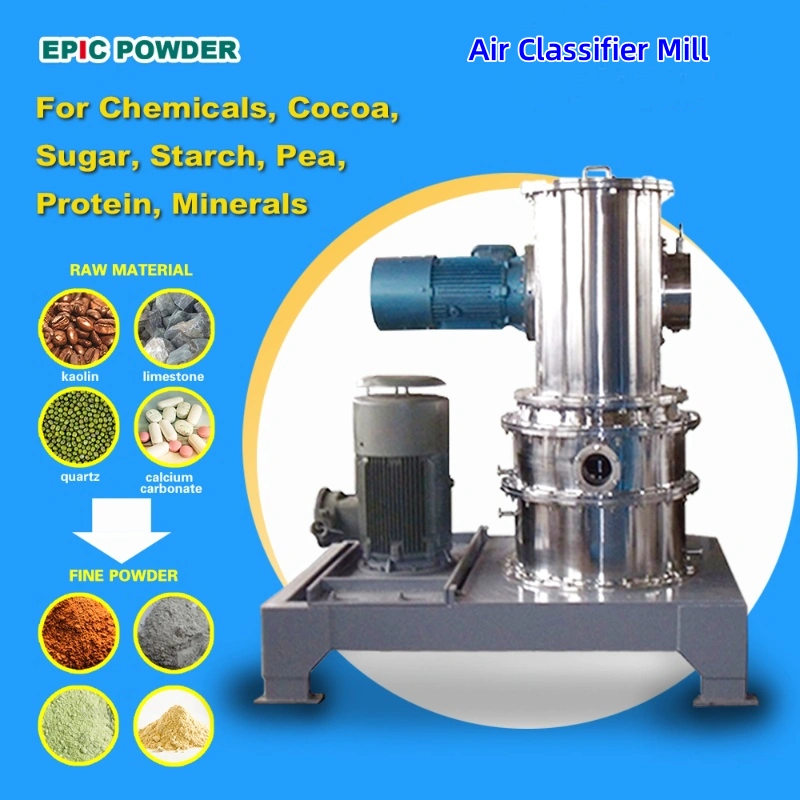
Air classifier mills play a crucial role in achieving the desired starch particle size, especially reaching a fine d97 of 100μm. These mills combine impact grinding with built-in air classification, ensuring consistent, ultra-fine starch powder without over-grinding or damaging starch granules. This integrated approach improves starch extraction yield and product quality.
Benefits of Integrated Air Classification:
- Maintains uniform particle size distribution
- Prevents starch granule damage
- Reduces energy consumption compared to separate grinding and classifying steps
- Produces micronized potato starch ideal for premium food and industrial uses
Epic Powder offers specialized air classifier mill solutions designed for potato starch. Their equipment balances capacity, energy efficiency, and easy maintenance, making them a preferred choice in industrial potato starch production.
Post-Grinding Steps: Separation and Refining
After grinding, the starch slurry contains fibers and impurities that need to be removed to ensure high-quality potato starch. This separation is crucial because leftover fibers can affect the purity and performance of the final starch powder.
Common techniques include centrifugal sieving, which efficiently filters out coarse fibers, and hydrocyclone refining, where powerful centrifugal forces separate finer impurities from the starch milk. These processes help achieve a clean starch slurry with minimal contaminants.
In addition to impurity removal, controlling moisture is essential. Techniques like vacuum dewatering reduce excess water content, preparing the starch milk for drying without causing clumping or degradation. This step ensures the starch powder retains its desired properties, such as flowability and particle stability.
Together, these post-grinding separation and refining steps play a vital role in producing ultra-fine, pure potato starch ready for drying and packaging.
Applications of Finely Ground Potato Starch
Finely ground potato starch, especially with a particle size of d97: 100μm, is highly valued across multiple industries due to its superior functionality. In the food industry, it serves as an excellent thickener and binder, improving texture and stability in soups, sauces, and gluten-free products. Its ultra-fine nature allows for smooth incorporation without altering taste or appearance, making it ideal for premium food formulations.
Beyond food, its fine granularity benefits industrial and pharmaceutical applications. In pharmaceuticals, the micronized potato starch acts as a reliable excipient and disintegrant, aiding in tablet formulation and drug delivery systems. Industrially, its consistent particle size supports applications like adhesives, paper coating, and textiles where uniform performance is essential.
Conclusion
Epic Powder’s advanced potato starch grinding equipment and air classifier mills enable precise control of starch fineness (d97: 100 μm), significantly improving product consistency, functionality, and shelf life. This fine and uniform particle size distribution ensures better dispersibility, faster hydration, and easier processing—all of which are critical for high-value end products.

“Thanks for reading. I hope my article helps. Please leave a comment down below. You may also contact Zelda online customer representative for any further inquiries.”
— Posted by Emily Chen