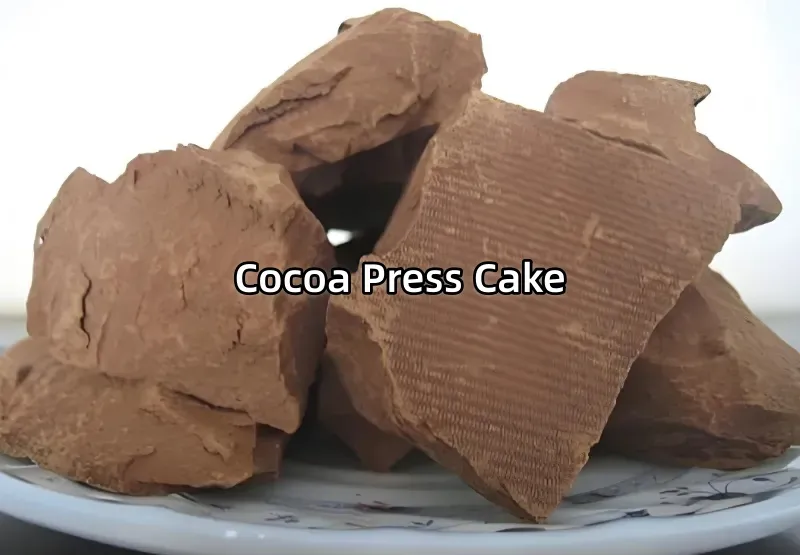
Cocoa press cake is the solid residue obtained after extracting cocoa butter from cocoa beans, typically containing 10%–24% residual cocoa fat. It is the primary raw material for producing high-quality cocoa powder. In the chocolate, bakery, beverage, and cosmetics industries, the particle size of cocoa powder directly affects product mouthfeel, solubility, and stability. Ultrafine grinding aims to reduce cocoa press cake to a powder with a median particle size (D50) below 10 μm, improving its dispersibility and application performance. However, its high fat content, thermal sensitivity, and tendency to agglomerate make traditional grinding equipment unsuitable. The Air Classifier Mill (ACM)—a combined impact mill with built-in dynamic classification—has become the ideal solution for achieving ultrafine grinding of cocoa press cake. This article explains the working principle of ACM systems, the processing steps, key parameters, and their advantages.
Working Principle of the Air Classifier Mill (ACM)
The ACM is an efficient dry grinding system consisting of a feeding unit, grinding chamber, high-speed rotor (impact hammers or pins), built-in dynamic classifier, airflow system, and powder collection unit. Its key feature is the integration of grinding + classification, which prevents over-grinding and ensures narrow particle size distribution.
Grinding Process
The raw material enters the grinding chamber via a screw feeder. The high-speed rotor (running at several thousand rpm) generates intense impact, shear, and friction forces that break the cake into fine particles. Simultaneously, compressed air (or nitrogen) creates a high-velocity airflow that accelerates particle-to-particle collisions, further refining the powder.
Classification Process
The built-in classifier wheel separates particles using centrifugal force and airflow resistance:
- Fine particles that meet the target size pass through the classifier
- Coarse particles return to the grinding zone for further milling
This forms a closed-loop system with excellent particle size control.
Suitable for Cocoa Press Cake
ACM systems efficiently handle materials with up to 24% fat content. Since the airflow provides natural cooling, heat buildup is minimized, avoiding fat melting, caking, or product degradation.
Compared with hammer mills or ball mills, ACMs deliver higher efficiency, narrower particle distribution, and better temperature control—making them ideal for heat-sensitive food materials.
Steps for Achieving Ultrafine Grinding of Cocoa Press Cake with ACM
A systematic workflow is required to produce consistent, high-quality ultrafine cocoa powder.
Raw Material Preparation
- Select cocoa press cake with 10%–24% fat content; moisture should be <5% to prevent sticking.
- Pre-crushing: Use a hammer mill or roller crusher to crush the cake to <5 mm before feeding; this prevents clogging in the ACM.
- Drying: If needed, dry the material at low temperature until moisture is <2% to increase efficiency.
Equipment Setup and Parameter Optimization
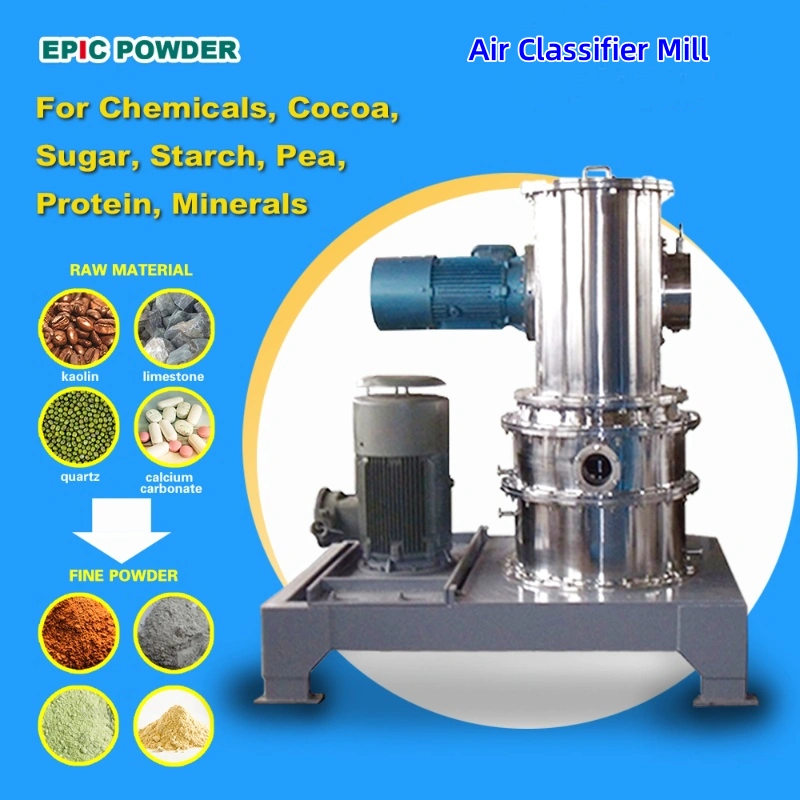
- Install the ACM and connect compressed air (0.6–0.8 MPa) and dust collection system.
- Key adjustable parameters:
- Rotor speed: 3000–6000 rpm. Higher speed yields finer powder, but the temperature must remain <50°C.
- Classifier wheel speed: 1000–4000 rpm, controlling D50 between 5–20 μm.
- Airflow: 500–2000 m³/h to ensure proper dispersion.
- Feed rate: 50–500 kg/h (depending on model) to avoid overloading.
Grinding Operation
- Start the system and allow a 5–10 minute warm-up.
- Feed pre-crushed cake evenly; coarse particles automatically recirculate while fine particles exit through the cyclone or bag filter.
- Monitor particle size using online laser diffraction analyzers to maintain D90 < 30 μm.
Post-Processing and Quality Control
- Collect the ultrafine cocoa powder and sieve if necessary.
- Test key properties:
- Particle size distribution
- Specific surface area (>2 m²/g)
- Flowability
- Color consistency
- Package the powder in sealed, moisture-proof containers.
The entire process can be run continuously, with single-machine capacities reaching several hundred kilograms per hour.
Advantages of ACM for Grinding Cocoa Press Cake

The ACM has proven highly effective in cocoa processing. Below is a comparison with traditional mills:
| Item | Air Classifier Mill (ACM) | Traditional Hammer Mill / Ball Mill | Advantage Summary |
|---|---|---|---|
| Particle size control | D50: 5–10 μm, narrow distribution | D50: 20–50 μm, wide distribution | Built-in classifier ensures uniformity |
| Fat content handling | Up to 24% | <10%; prone to sticking | Cooling airflow prevents degradation |
| Energy consumption | Low (50–100 kWh/t) | High (>150 kWh/t) | Closed loop, higher efficiency |
| Throughput | 100–1000 kg/h | 50–300 kg/h | Supports continuous industrial production |
| Cleanability | Easy, GMP-compliant | Difficult, contamination-prone | Food-grade hygienic design |
| Investment | Medium | Low | Higher long-term ROI; no additional classifier needed |
Practical Case and Operating Tips
A cocoa processor in Cameroon adopted an ACM system to grind pre-crushed cocoa press cake into high-quality cocoa powder for premium chocolate production. The resulting powder showed:
- 30% improvement in solubility
- noticeably smoother mouthfeel
Key Considerations
- Safety: Use nitrogen instead of air to prevent dust explosions (cocoa powder is combustible).
- Maintenance: Inspect rotor and classifier frequently; clean the system every 1000 hours.
- Environmental: Use high-efficiency dust collectors to meet <10 mg/m³ emissions.
- Troubleshooting: For high-fat materials, add a small amount of anti-caking agent (e.g., silicates) or reduce feed rate.
Conclusion
Using an Air Classifier Mill to produce ultrafine cocoa powder overcomes the limitations of traditional grinding methods and significantly enhances product value. With precise parameter control and an integrated design, ACM systems deliver efficient, uniform, and temperature-stable grinding, supporting the growing demand for finely processed cocoa products.
As food-processing technologies advance, ACM mills will continue to play a crucial role in the grinding of heat-sensitive materials. Cocoa processors are encouraged to begin with lab-scale ACM trials and gradually optimize parameters for full-scale commercial production.

“Thanks for reading. I hope my article helps. Please leave a comment down below. You may also contact Zelda online customer representative for any further inquiries.”
— Posted by Emily Chen