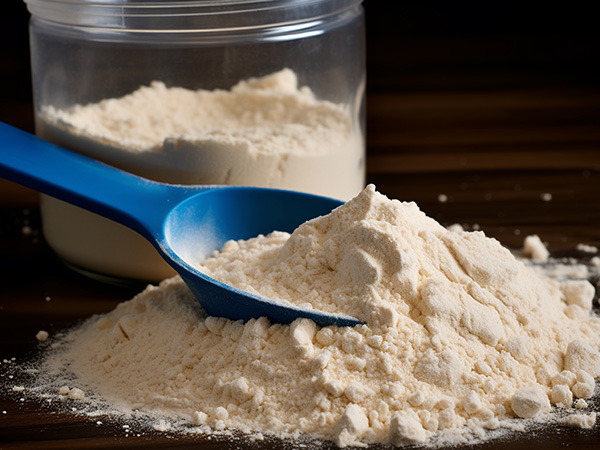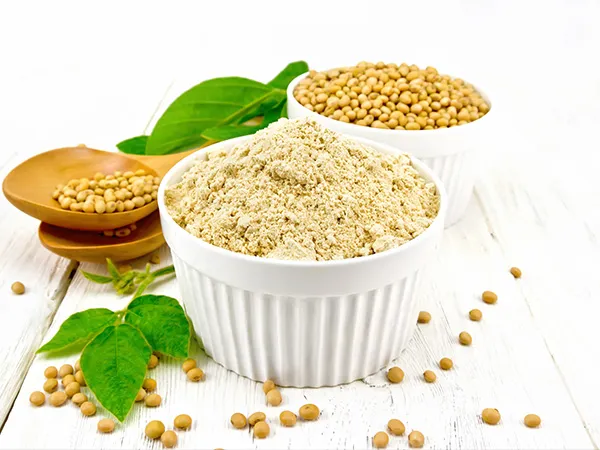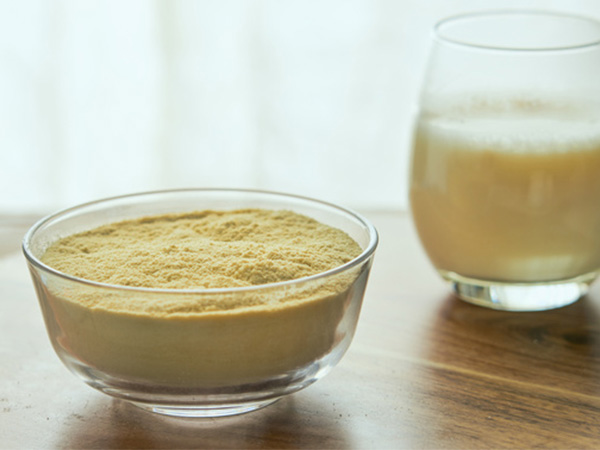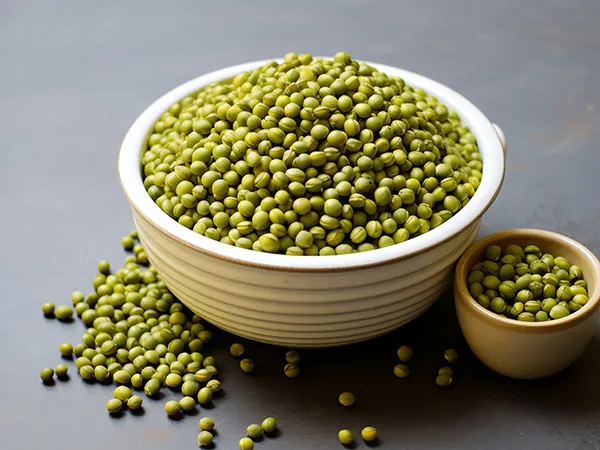
Soy Protein Isolate (SPI) is currently the highest-purity and most widely used functional plant protein, with a protein content typically ≥90%. It is extensively applied in meat products, dairy alternatives, nutrition bars, sports foods, and plant-based beverages. However, in industrial production, SPI yield (also called recovery) has long stagnated at 75%–88%, with 10%–25% of protein lost in okara, whey, and process losses. This remains a key bottleneck restricting cost efficiency and resource utilization.
The core limitation of the traditional alkaline extraction and acid precipitation process lies in the fact that protein bodies in defatted soybean meal are tightly encapsulated within cell wall fragments, fiber networks, and residual oil, making it difficult for the alkaline solution to fully penetrate and dissolve all protein. As a result, a significant proportion of protein remains insoluble in the okara. In recent years, Soy Protein Isolate ultrafine grinding combined with air classification—as a dry physical pretreatment—has been demonstrated as one of the most cost-effective upstream technologies for improving SPI yield. This article focuses on the concept of “starting from ultrafine grinding and air classification of defatted soybeans,” systematically explaining the mechanism, process essentials, influencing factors, actual improvement levels, and complementary optimization strategies.
1. Why Ultrafine Grinding Significantly Improves Soy Protein Isolate Extraction
In defatted soybean meal (typically low-temperature solvent-extracted, NSI 70–85), approximately 60%–70% of the protein exists as protein bodies with diameters of 1–3 μm. These protein bodies are encapsulated in cell wall fragments 0.5–2 μm thick, along with small amounts of cellulose and hemicellulose networks. Conventional milling (40–80 mesh, ~200–400 μm) only breaks up large particles, leaving many protein bodies still encapsulated. During alkaline extraction, the contact area between protein and solvent is limited.
The goal of ultrafine grinding is to reduce the overall particle size of the material to 10–30 μm (D90), with some portions even reaching 5–15 μm, thereby mechanically tearing most cell walls and liberating the protein bodies. At this point, the protein’s specific surface area can increase 5–20 times, shortening the diffusion path for the alkaline solution and significantly reducing protein extraction resistance.
More importantly, coupled with air classification, protein can be pre-enriched:
- Protein bodies density ≈ 1.3–1.4 g/cm³, small particle size, high sphericity
- Fiber fragments density ≈ 0.8–1.1 g/cm³, larger particle size, flaky
In an air classifier (typically turbine-type or cyclone-type), the light fraction (coarse fiber) is separated, and the heavy fraction (protein-rich) enters the subsequent extraction stage. This “dry pre-enrichment + ultrafine exposure” combination can increase the protein content of raw material entering alkaline extraction from 48%–52% to 58%–68%, laying a foundation for high extraction yield.
According to literature and patents, ultrafine dry grinding combined with classification can generally improve SPI yield by 8–18 percentage points, with some optimized cases even surpassing 92%–95%.
2. Soy Protein Isolate Ultrafine Grinding and Air Classification Process Pathway and Key Equipment
A typical industrial process is as follows:
- Raw Material: Low-temperature solvent-extracted defatted soybean meal (NSI ≥75%, moisture ≤10%, fat ≤1.0%)
- Coarse Grinding → hammer or roller crusher → 40–60 mesh (250–400 μm)
- Ultrafine Grinding → Main industrial equipment (ordered by achievable D90 from fine to ultra-fine):
- Jet mill: D50 2–8 μm, suitable for high precision but high energy consumption
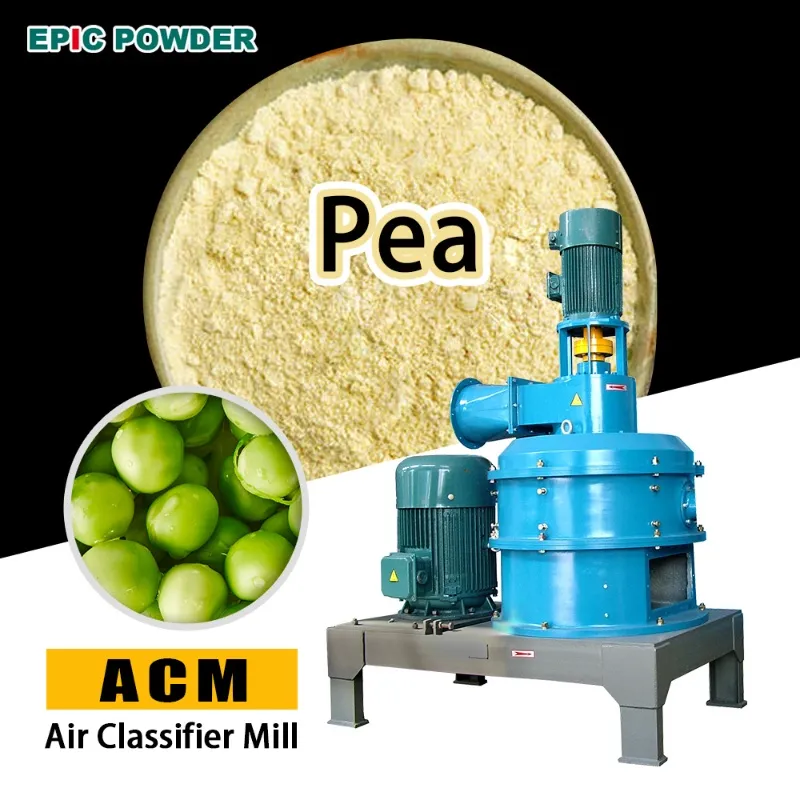
- Mechanical impact mill with built-in classifier (e.g., ACM, MJL series): D90 10–25 μm, best cost-performance, industrial mainstream
- Pin/hammer ultra-fine mill with external classifier: D90 15–35 μm, high capacity
- Vibratory/planetary mill (mainly lab use): D90 <5 μm, poor continuous production
- Air Classification → turbine classifier or multi-stage serial classification, cut point usually set at 15–30 μm
- Coarse fraction removes fiber tailings (protein 15%–25%)
- Fine fraction enriches protein (58%–68%)
- Ultrafine Protein Powder → directly enters alkaline extraction or short-term sealed storage
Key process parameters:
- Target D90: 12–22 μm recommended (too fine causes agglomeration and excessive energy consumption)
- Classification cut point: 18–28 μm (adjusted according to soybean meal quality)
- Feed moisture: ≤8% (higher moisture causes sticking and caking)
- System temperature: <55℃ (protein denaturation threshold ~60–65℃)
- Specific energy consumption: ACM system ~80–160 kWh/t (increases with fineness)
3. Quantitative Impact on SPI Yield
Based on recent research and industrial practice:
- Conventional, non-ultrafine: 76%–84% yield
- Ultrafine D90 ≈25 μm + classification: 84%–89% (+6–10%)
- Ultrafine D90 ≈15 μm + optimized classification: 89%–93% (+10–15%)
- Ultrafine D90 <10 μm + multi-stage classification + enzyme/ultrasound synergy: 93%–96% (+15–20%)
Case Study (2024–2025 factory data):
- Original process: protein 51.2%, SPI yield 81.6%, okara protein 18.7%
- With ACM ultrafine (D90 18 μm) + secondary classification: protein in fine fraction 63.8%, SPI yield 91.2%, okara protein 9.4%
Protein loss was reduced by about half, resulting in significant economic benefits.
4. Downstream Extraction Optimization after Ultrafine Pretreatment
While ultrafine pretreatment greatly exposes protein, if subsequent extraction conditions are not adjusted, issues such as poor emulsification, inefficient centrifugation, or incomplete acid precipitation may occur. Recommended adjustments:
- Alkaline Extraction
- Material-to-water ratio: 1:6–1:8 (lower than usual because ultrafine powder absorbs more water)
- pH: 7.0–7.4 (traditional 7.8–8.5 may over-extract fiber, increasing viscosity)
- Temperature: 32–42℃ (higher may cause microbial contamination and slight protein denaturation)
- Time: 20–35 min (solubilization is faster, time can be reduced by 30%–50%)
- Optional additives: 0.05%–0.2% reducing agents (e.g., Na₂SO₃) or proteases (Alcalase 0.05%–0.1%) to further enhance yield
- Separation: Recommend two-stage decanter centrifuge or combination with disc separator to ensure clarity
- Acid Precipitation: pH 4.3–4.6, slowly lowering pH (>15 min) to avoid localized over-acidification
- Washing: Two-stage countercurrent washing, ash content ≤5.5%
- Sterilization and Drying: Ultrafine protein slurry is highly viscous; recommended: UHT instant sterilization + high-pressure homogenization + spray drying
5. Potential Issues and Solutions
- Over-grinding causing agglomeration
→ Keep D90 above 15 μm, or add 0.2%–0.5% food-grade anti-caking agents (e.g., calcium silicate, tricalcium phosphate) - Energy consumption vs. production capacity
→ Prefer mechanical impact mills with built-in classifier; single machine capacity 1–3 t/h - Residual fiber affecting centrifugation
→ Strengthen classification, implement two or three-stage classification to remove coarse fiber - Functional changes
→ Solubility, foaming, and emulsification usually improve; gel strength may slightly decrease. Moderate heat treatment (80–90℃, 30–60 s) or transglutaminase crosslinking can compensate
6. Conclusion and Outlook
Starting from ultrafine grinding and air classification of defatted soybeans is currently one of the most industrially feasible paths for improving SPI yield. It physically liberates protein bodies to the maximum extent, significantly reducing the difficulty of subsequent chemical/enzyme extraction, achieving systematic optimization of “reducing loss upstream, increasing efficiency downstream.”
Looking forward, with large-scale air jet mills (>5 t/h per machine), AI adaptive classification control, low-temperature ultrafine grinding (-40℃ frozen milling), and further maturity of dry electrostatic or electrostatic separation, SPI yield is expected to stabilize at 93%–96%, with
“Thanks for reading. I hope my article helps. Please leave a comment down below. You may also contact Zelda online customer representative for any further inquiries.”
— Posted by Emily Chen