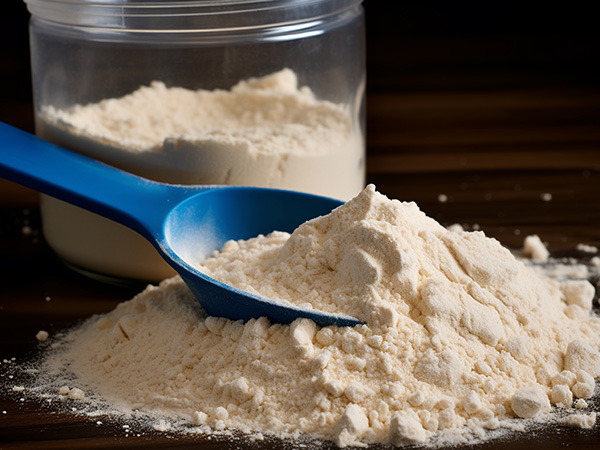
In the fields of functional food ingredients, Foods for Special Medical Purposes (FSMP), and high-end pet nutrition, chicken protein has become a high-quality source of animal protein due to its high biological value, balanced amino acid composition, and low fat content. However, dehydrated chicken protein—especially portions containing connective tissue or high-fiber components—possesses extreme toughness and fibrous structure. Traditional grinding methods often fail to achieve the desired ultrafine particle size and can easily lead to protein denaturation. The Air Classifier Mill (ACM), with its unique “grinding-classification integration” design, has gradually become the recognized preferred equipment in this field. This article deeply analyzes the irreplaceability of ACM in ultrafine grinding of chicken protein from four dimensions: material characteristics, equipment principles, temperature control mechanisms, and finished product quality.
I. Challenges: Ultrafine Grinding Pain Points of High-Fiber Chicken Protein
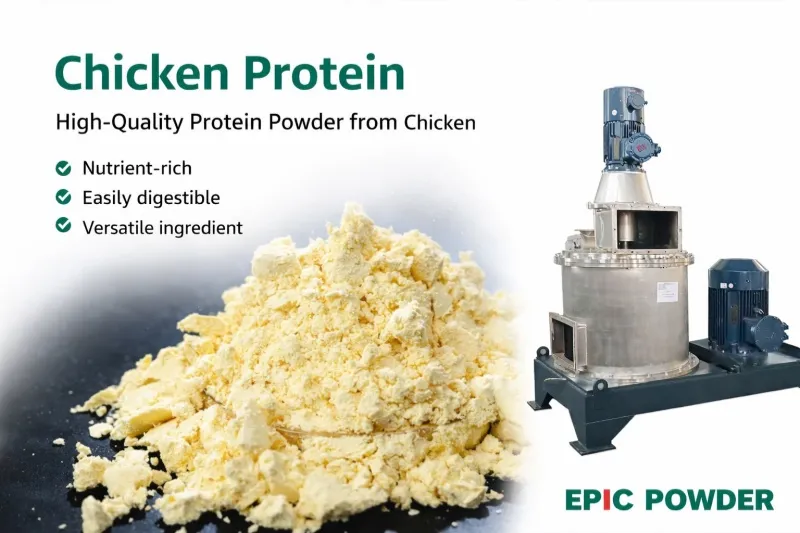
Before discussing equipment, it is necessary to understand why chicken protein is “stubborn” during grinding:
- High toughness and fiber content:
Chicken protein contains a large amount of collagen and muscle fibers. After dehydration and drying, these fibers become extremely tough. Ordinary shear or impact mills can only “break apart” the fibers rather than “pulverize” them, resulting in a noticeable fibrous texture in the final product. - Heat sensitivity:
Proteins denature under high temperatures. If the heat generated during grinding cannot be dissipated in time, the solubility, emulsifying properties, and nutritional value of chicken protein will decrease significantly, potentially resulting in a burnt taste. - Hygroscopicity and adhesion:
Animal protein contains some fat and polar groups, which can cause sticking to walls due to static electricity or temperature rise during grinding, blocking the screen.
II. Working Principle of ACM: Combining Dynamics and Precision
The ACM is not just a single mill; it is a complex system integrating high-speed impact, collision, friction, and centrifugal classification.
- Impact Grinding Zone:
Material is fed into the grinding chamber via a feeding system and subjected to intense impact from high-speed rotating hammers (or pins). For high-fiber chicken protein, this high-speed impact generates enormous shear forces instantaneously, breaking the tough fibers. - Airflow Circulation and Suspension:
Unlike traditional mills, ACM features abundant circulating air. Materials are suspended in the grinding chamber, a “dynamic grinding” state that reduces hard contact with the chamber walls, minimizing wear. - Built-in Turbine Classification System:
This is the core competitiveness of ACM. Above the grinding chamber, a high-speed rotating classification wheel is installed.- Qualified fine powder: Carried by the airflow, overcoming centrifugal force, enters the collection system.
- Coarse powder/fibers: Influenced by centrifugal force, returned to the grinding zone for reprocessing.
This mechanism ensures chicken protein is not “over-ground,” and the final product particle size distribution (PSD) is extremely narrow.
III. Why ACM is the “Preferred Choice”
In ultrafine grinding of high-fiber chicken protein, different equipment varies significantly in performance due to working principles, structure, and applicability. The Air Classifier Mill (ACM) integrates mechanical impact grinding with dynamic air classification, achieving “grinding + classification” in one system. It is particularly suitable for tough, entangled, and heat-sensitive high-fiber materials. By contrast, other equipment shows shortcomings in fiber dispersion, temperature control, particle size precision, energy consumption, or sanitation.
The following table compares ACM with other common mills across multiple critical dimensions (based on typical industry applications and equipment performance):
Comparison with Other Ultrafine Pulverizing Equipment
| Comparison Dimension | ACM (Air Classifier Mill) | Traditional Hammer/Impact Mill | Colloid Mill | Jet Mill |
|---|---|---|---|---|
| Working Principle | Mechanical impact + dynamic air classification (integrated closed-loop) | High-speed hammering + screen-based particle size control | Wet shear (stator-rotor gap) | High-pressure air collision (no mechanical parts) |
| Suitability for high-fiber materials | Excellent: airflow disperses fiber bundles, no screen clogging, ideal for tough fiber networks | Poor: fibers entangle hammers/screens, frequent stoppages | Poor: dry operation easily jams gaps, wet requires extra drying | Moderate: weak initial coarse grinding, poor fiber dispersion |
| Particle size control & distribution | Excellent: dynamic classification wheel ensures narrow distribution (D90 stable at 5–20 μm, steep curve) | Poor: screen-controlled, wide distribution, many over/under-sized particles | Moderate: wet fine powder good, dry hard to control | Excellent: can reach submicron, distribution requires extra classification |
| Temperature control (heat-sensitive protein protection) | Excellent: high airflow cooling, exit temp <40–50°C, protects protein from denaturation | Poor: high impact heat, protein denatures easily | Poor: shear friction generates significant heat | Excellent: no mechanical friction, minimal temperature rise |
| Energy consumption & efficiency | Medium-low: integrated design, continuous production, lower energy consumption, high throughput | Medium-low: simple but efficiency drops due to clogging | Medium-high: wet requires subsequent drying, energy increases | High: compressed air consumes a lot, throughput limited |
| Throughput & continuity | High: suitable for industrial-scale continuous production, high single-machine capacity | Medium-high: fiber material prone to interruption | Medium: wet continuous, but long overall process | Low: limited single-pass capacity |
| Sanitation & cleaning | Excellent: no screen, negative pressure operation, easy CIP cleaning, meets GMP/HACCP, minimal dust leakage | Moderate: screens retain residue, difficult to clean | Moderate: wet prone to microbial contamination | Excellent: no mechanical parts, low contamination |
| Equipment investment & maintenance | Medium-high: initial cost relatively high, but long-term cost-effective (low maintenance) | Low: simple structure, easy maintenance | Medium: frequent gap adjustment | High: complex compressor system, high maintenance cost |
.webp)
IV. Process Optimization and Practical Applications
Typical ACM processing flow for high-fiber chicken protein:
- Raw material pretreatment: Fresh chicken or by-products are washed, cooked, or enzymatically hydrolyzed, minced into a paste, dried to <10% moisture, and coarsely ground to <1 mm.
- ACM ultrafine grinding: Control feed rate, set classification parameters, target fineness D90 <15 μm. Monitor outlet temperature and current to ensure stability.
- Post-processing: Collect powder, package, or further modify (e.g., combined with spray drying or encapsulation).
- Quality control: Measure particle size distribution (laser granulometer), protein content, solubility, microbiological indicators, etc.
In practice, ACM has demonstrated significant value in similar chicken protein powder ultrafine grinding. For example, in plant or animal protein ultrafine processing, using ACM increases solubility by over 30%, and texture transforms from “gritty” to “silky.” For chicken protein, combined with enzyme pretreatment, ACM can produce high-protein powders suitable for baking, solving textural deterioration issues at high inclusion levels.
Industrial cases show that a food company using ACM for chicken protein processing at ton-scale daily achieves fast-dissolving, odorless products for functional beverages. Compared to traditional methods, maintenance costs are lower, and output increases by 25%.
V. Application Prospects: Value Leap of Ultrafine Chicken Protein
After ultrafine processing with ACM, the physicochemical properties of chicken protein undergo transformative improvements:
- Improved bioavailability: Smaller particle size increases contact area with digestive enzymes, significantly improving absorption, crucial for elderly or post-surgery foods.
- Enhanced processing performance: Ultrafine protein powders exhibit stronger water and oil retention, usable as natural thickeners or emulsifiers in meat products or sauces, replacing chemical additives.
- Texture revolution: Completely solves the “settling” and “grittiness” problems of animal protein in liquid applications.
VI. Conclusion
In today’s era of biotechnology and food industry integration, grinding is no longer simply “making large particles smaller,” but a reconstruction of the
material’s microstructure. The Air Classifier Mill (ACM), with its unique advantages in precise particle size control, low-temperature operation, and screenless design, perfectly meets the processing needs of high-fiber chicken protein.
For food enterprises seeking product upgrades, investing in a scientifically configured ACM system is not just a choice of efficient production, but also provides strong technical support for high added-value and core competitiveness of the product.
Tip: During actual selection, it is recommended to bring raw materials to a laboratory for testing. Different drying methods (spray drying vs. freeze drying) produce chicken protein with significantly different physical properties. Using measured data to determine fan pressure and classifier disc speed is the key to achieving optimal yield.

“Thanks for reading. I hope my article helps. Please leave a comment down below. You may also contact Zelda online customer representative for any further inquiries.”
— Posted by Emily Chen