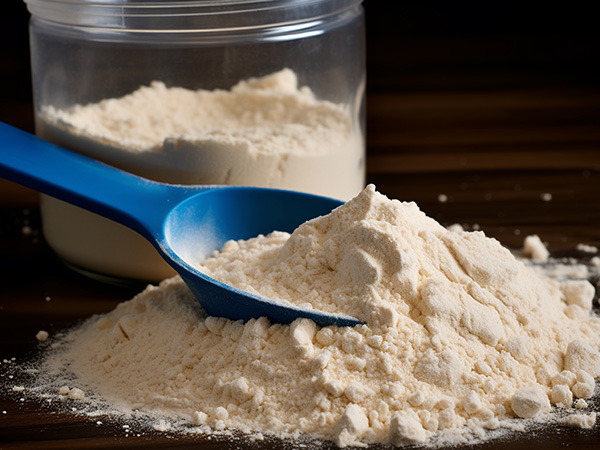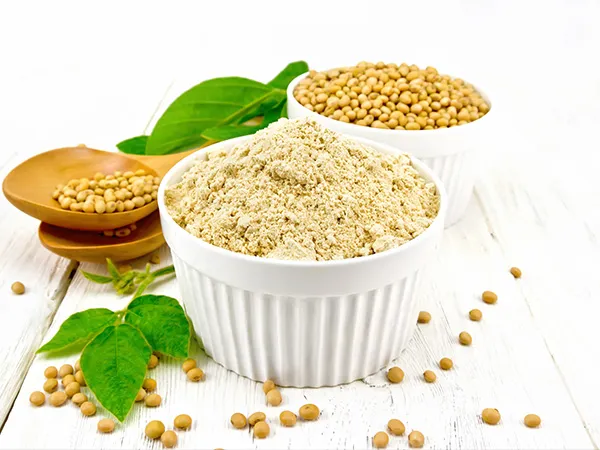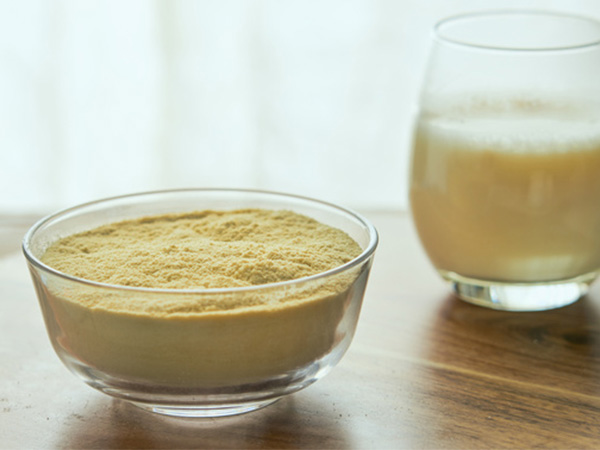
After intense exercise, muscle fibers experience microscopic tears, and the muscle protein synthesis window opens. Supplementing with high-quality protein at this time can significantly accelerate muscle repair, reduce delayed-onset muscle soreness (DOMS), and improve performance in subsequent training sessions. Soy Protein Isolate (SPI), as a plant-based complete protein, stands out with its high purity (protein content ≥90%), low fat and carbohydrate levels, and balanced amino acid profile. It becomes an ideal choice. The “dispersible” version of Soy Protein Isolate further enhances convenience and effectiveness. When combined with air classifier mill (ACM) protein separation technology, its ultra-fine particle characteristics make instant mixing and rapid absorption a reality. This article explores the necessity of supplementing dispersible Soy Protein Isolate after exercise. It also analyzes in detail how ACM technology revolutionizes the production process of SPI, achieving a leap from traditional coarse powder to highly dispersible products.
1. Core Nutritional Recovery Needs After Exercise
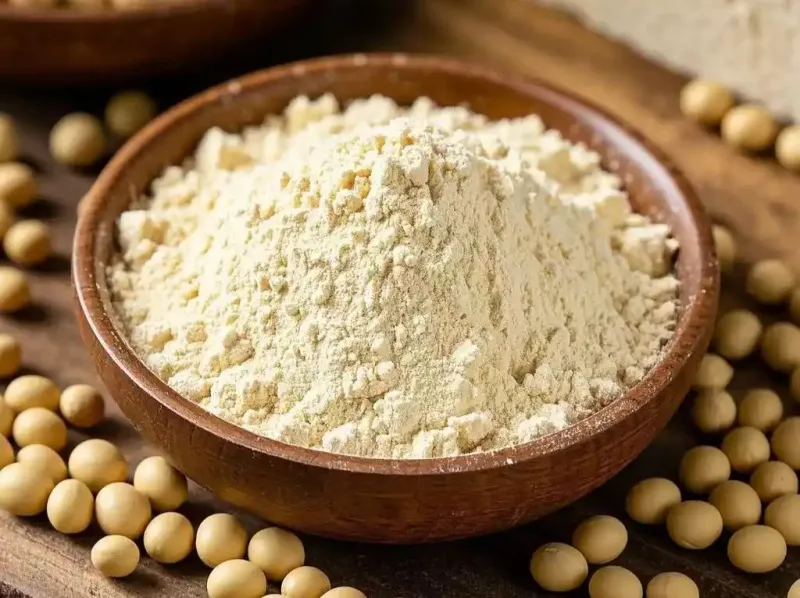
Following high-intensity training, the body enters a state where breakdown exceeds synthesis. Muscle damage triggers inflammatory responses, elevating serum creatine kinase (CK) levels and accumulating metabolic waste such as lactic acid and uric acid. At this point, protein supplementation stimulates muscle protein synthesis (MPS) by providing essential amino acids (EAAs), particularly branched-chain amino acids (BCAAs). Studies show that consuming 20-40g of high-quality protein within 30-60 minutes after exercise can increase MPS by 2-3 times.
Soy protein isolate contains all nine essential amino acids required by the human body, making it a complete protein. Although its leucine content is slightly lower than that of whey protein, multiple randomized controlled trials indicate that SPI supplementation excels in reducing exercise-induced muscle damage (EIMD). One study on trained athletes found that supplementing 25g of SPI twice daily significantly alleviated EIMD and accelerated muscle recovery. Meta-analyses confirm that SPI and whey protein produce no significant differences in increasing lean body mass and strength over 12 weeks of resistance training.
Compared with animal proteins, SPI offers additional advantages: it is cholesterol-free and low in saturated fat. It can lower serum triglycerides, uric acid, and lactate levels while improving oxidative stress. For vegetarians, individuals with lactose intolerance, or those seeking sustainable protein sources, SPI is a preferred option. However, traditional SPI often suffers from clumping and poor solubility, which affects the “mix-and-drink” experience urgently needed after exercise. Dispersible Soy Protein Isolate addresses this pain point through advanced technology, making protein supplementation truly efficient and convenient.
2. Dispersible Soy Protein Isolate: Evolution from “Soluble” to “Instantly Soluble”
“Dispersible” does not simply mean improved solubility. It refers to the powder’s ability to wet, disperse, and avoid clumping quickly in water. The core lies in particle size, surface properties, and flowability. Traditional SPI particles are mostly above 100-200μm with strong surface hydrophobicity. They tend to float or clump, resulting in a gritty feel or sedimentation after mixing. Dispersible Soy Protein Isolate achieves D90 <25μm or even finer through ultra-fine grinding. This increases the specific surface area of particles, exposes more hydrophilic groups, and shortens wetting time to just a few seconds.
The advantages of dispersibility for post-exercise supplementation are obvious:
- Convenience: After gym or outdoor training, no blender is needed. A few shakes create a uniform dispersion, saving time.
- Rapid Absorption: Fine particles speed up digestion in the gastrointestinal tract, allowing amino acid peaks to appear earlier and maximizing use of the “synthesis window.”
- Mouthfeel and Compliance: The smooth, particle-free texture improves daily supplementation adherence and reduces digestive burden. The body can focus on repair rather than “processing” the powder.
- Improved Bioavailability: Research indicates that ultra-fine powders enhance in vitro digestibility and in vivo absorption efficiency of proteins while lowering gastrointestinal discomfort.
It is precisely this “instant mix and use” characteristic that makes dispersible SPI the top choice after exercise. Its realization depends on air classifier mill technology.
3. Principles and Innovations of Air Classifier Mill (ACM) Protein Separation Technology
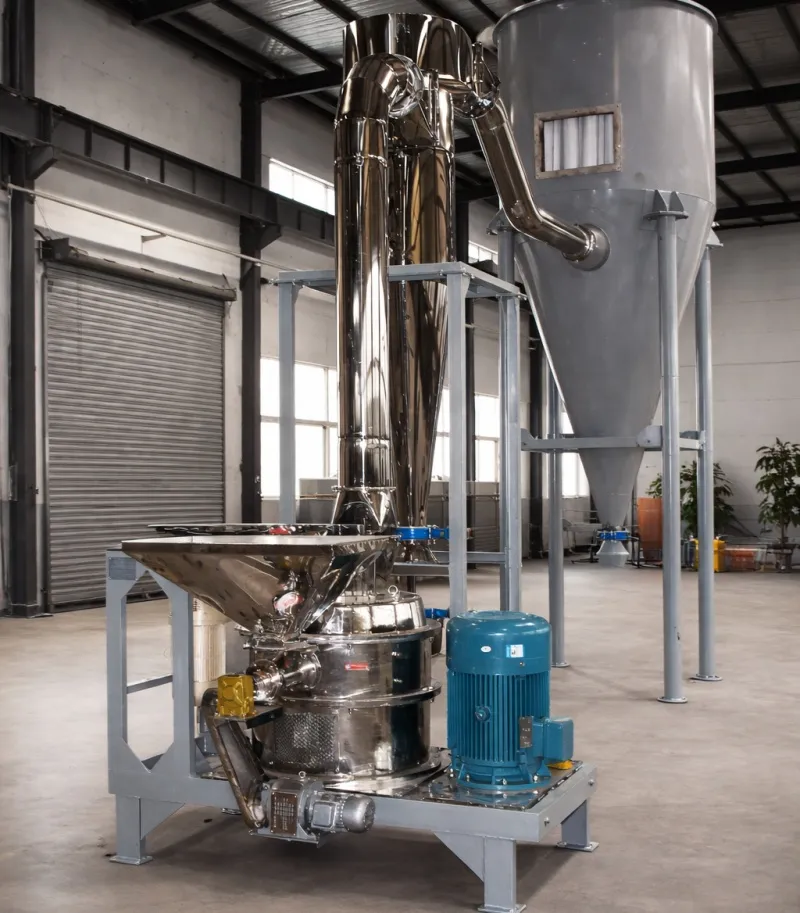
The air classifier mill (ACM) is a dry ultra-fine grinding equipment that integrates impact milling with dynamic air classification. Its core structure includes a rotor (impact grinding disc), classifier wheel, air circulation system, and collector. During operation, material is shattered by the high-speed rotating rotor. At the same time, airflow carries fine particles upward to the classification zone. Coarse particles fall back due to centrifugal force for re-grinding, creating a closed-loop “grind-and-classify” process.
In Dispersible Soy Protein Isolate production, ACM is mainly applied in:
- Dry protein enrichment/separation: It grinds defatted soy flour or concentrate to micron level. Precise classification occurs based on particle size and density differences between protein bodies (~3-10μm) and starch/fiber (15-40μm). Protein enrichment rate can increase by more than 15%, with higher yield.
- Post-processing ultra-fine grinding of SPI: It performs secondary refinement on wet-extracted SPI to control D99 ≈90-100μm or finer (for example, one Indian plant project achieved D99=92.8μm at 1t/h capacity).
- Functional optimization: Low-temperature grinding (minimal heat generation) preserves the natural conformation of proteins and avoids denaturation. Air classification ensures a narrow particle size distribution (±5% fluctuation), improving flowability and dispersibility.
Compared with traditional wet extraction (alkali dissolution, acid precipitation, and spray drying), the ACM dry process offers revolutionary advantages:
- Environmentally friendly and energy-saving: It requires no large amounts of water resources and reduces wastewater treatment, aligning with green manufacturing.
- Activity preservation: Low-temperature operation suits heat-sensitive materials and maintains superior functional properties of proteins (such as gelling and emulsification).
- High dispersibility achievement: Ultra-fine and uniform particles directly impart “instant solubility” to the powder, eliminating the “gritty feel” and clumping issues of traditional SPI.
- Output and consistency: Automated classification provides high batch-to-batch stability, suitable for large-scale production of sports nutrition products.
For instance, Epic Powder’s ACM system in an Indian SPI project not only achieved high capacity but also delivered finished powder with “excellent dispersibility and smooth mouthfeel,” directly serving the premium sports supplement market.
4. Scientific Mechanisms by Which ACM Technology Empowers Post-Exercise SPI Supplementation
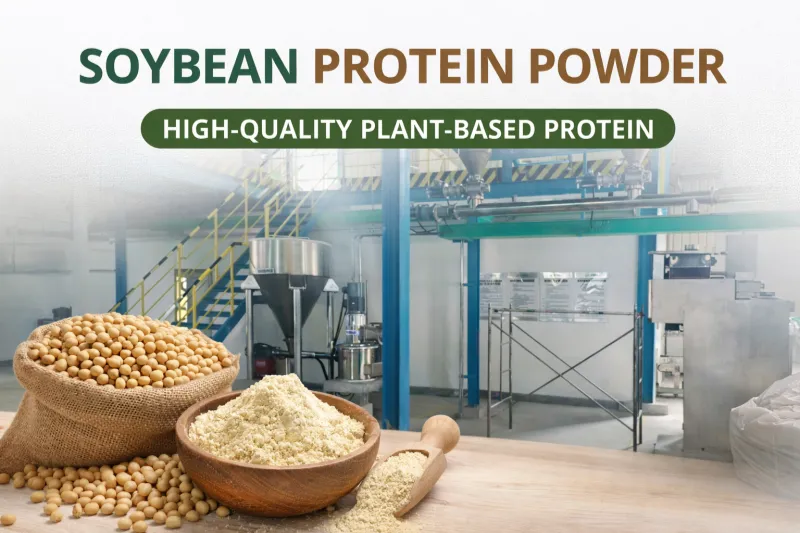
ACM-processed Soy Protein Isolate has smaller particles and more hydrophilic surfaces, significantly improving the powder dispersion index (PDI). When mixed immediately after exercise, the powder wets and disperses rapidly to form a uniform solution, avoiding gastrointestinal burden. Fine particles also increase contact area with digestive enzymes, accelerating peptide bond hydrolysis. This allows plasma amino acid concentrations to reach peaks faster and supports MPS.
ACM technology further amplifies these benefits. Finer particles enhance antioxidant capacity and reduce oxidative stress. The dry process preserves bioactive components such as isoflavones, aiding anti-inflammatory effects. Compared with traditional coarse SPI, the ACM version excels in mouthfeel, solubility, and absorption speed. It becomes “clean logistical support” for post-exercise needs.
5. Practical Application Recommendations and Precautions
Recommended dosage for post-exercise supplementation: For individuals weighing 60-80kg, 20-30g of SPI (about 1-1.5 scoops), paired with carbohydrates (such as bananas or oats) to optimize glycogen recovery and insulin-mediated amino acid uptake. Choose products certified with ACM processing and check packaging for labels like “ultra-fine powder,” “high dispersibility,” or particle size indicators.
Suitable populations include strength/endurance athletes, vegetarian fitness enthusiasts, and those in fat-loss phases (SPI is low in calories and provides strong satiety). Long-term use can also lower cholesterol and support cardiovascular health.
Notes: Although SPI is generally safe, individuals with soy allergies should use it cautiously. Mixing with whey can complement amino acid profiles. Store in a cool, dry place to avoid moisture affecting dispersibility.
6. Conclusion: A New Era of Protein Driven by Technology
Supplementing dispersible Soy Protein Isolate after exercise is no longer just “adding protein.” It represents precise nutrition. Air Classifier Mill protein separation technology, with its efficient dry method and ultra-fine precision, has completely revolutionized the production and application of SPI. It makes “instant solubility, good absorption, and no burden” a reality. From the laboratory to the gym, this technology is helping more people achieve efficient recovery and continuous progress.
In the future, with iterations of ACM processes (such as higher-precision classification and lower energy consumption), dispersible SPI will further integrate into personalized sports nutrition solutions. Choosing products empowered by ACM technology gives you not only high-quality plant protein but also the convenience and efficacy brought by science. After exercise, one shake of smooth, dispersible SPI is the best reward for your muscles—making recovery simpler and more efficient from now on.

“Thanks for reading. I hope my article helps. Please leave a comment down below. You may also contact Zelda online customer representative for any further inquiries.”
— Posted by Emily Chen