The global shift toward plant-based diets has transformed the humble yellow pea from a rotational crop into a cornerstone of the alternative protein industry. As demand for pea protein isolates and concentrates surges, manufacturers are under immense pressure to optimize production efficiency while maintaining the functional and nutritional integrity of the protein.
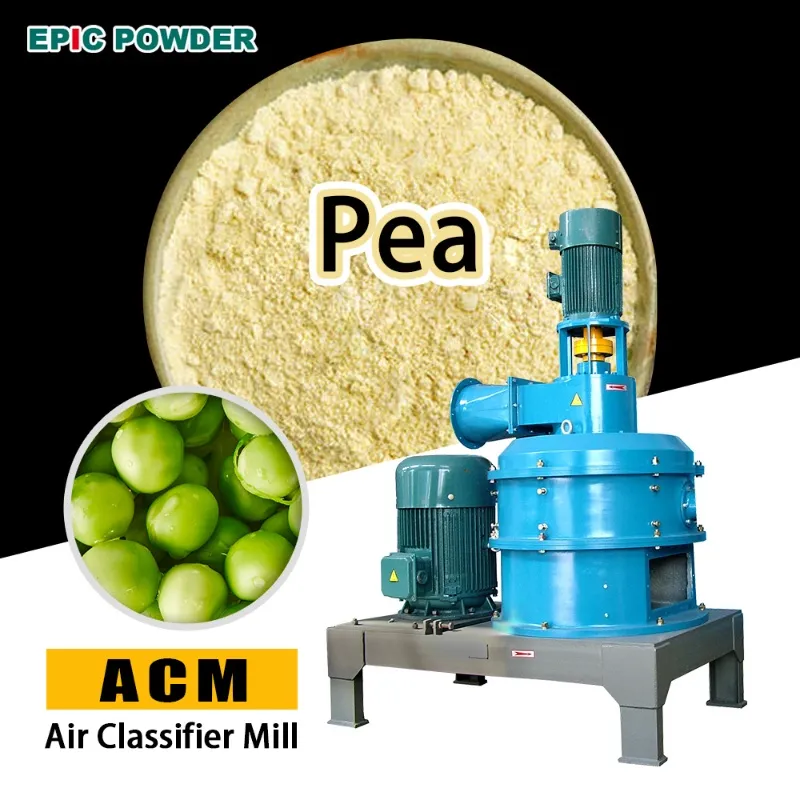
In the world of dry fractionation—a sustainable, chemical-free alternative to traditional wet extraction—one piece of equipment stands out as the industry standard: the Air Classifier Mill (ACM). This article explores why the ACM is the preferred choice for pea protein powder production and how it facilitates the complex process of shifting protein content from raw flour to high-value concentrate.
The Science of Pea Protein Extraction: Dry Fractionation
To understand why the air classifier mill is essential, we must first look at the structure of a pea. A dried pea consists primarily of starch granules (large, heavy) and protein bodies (small, fine). In dry fractionation, the goal is to detach these protein bodies from the starch without using water or chemicals.
This process involves two critical stages:
- Fine Grinding (Micronization): Breaking the pea flour down to a specific particle size where protein and starch are physically liberated from one another.
- Air Classification: Separating the lighter protein particles from the heavier starch granules using centrifugal force and airflow.
The ACM is a “two-in-one” solution that handles both stages simultaneously, making it an incredibly efficient tool for Pea Protein Powder Production.
Key Reasons Why Manufacturers Choose ACM
A. Integrated Grinding and Classification
Unlike traditional systems that require a separate mill and a standalone classifier connected by complex ducting, the air classifier mill integrates both functions in a single chamber.
- Efficiency: Material is ground and immediately classified. Particles that meet the target fineness exit the system, while “oversized” particles are automatically returned to the grinding zone.
- Reduced Footprint: By combining two machines into one, manufacturers save significant floor space in the factory.
B. Precision Control of Particle Size Distribution (PSD)
Pea protein concentration is highly sensitive to particle size. If the grind is too coarse, the protein remains “stuck” to the starch. If it is too fine, the energy consumption skyrockets, and the starch granules might break, making separation impossible.
The ACM allows for stepless speed adjustment of the internal classifier wheel. This precision enables manufacturers to dial in the exact “cut point” needed to maximize yield during Pea Protein Powder Production.
C. Temperature Management and Protein Quality
Protein is sensitive to heat. High temperatures during grinding can lead to “denaturation,” where the protein loses its solubility and functional properties (like foaming or gelling).
- High Airflow: ACMs operate with a high volume of air passing through the chamber. This air acts as a constant cooling medium, carrying away the heat generated by the mechanical impact.
- Nutritional Integrity: Because the material stays cool, the resulting pea protein powder maintains its “native” state, which is a major selling point for premium food brands.
D. Scalability and Consistency
In B2B trade, consistency is everything. A buyer in the United States expects the same D50 and protein percentage in May as they received in January. The automated nature of modern air classifier mills ensures that once the parameters are set, the output remains uniform across massive production batches.
Comparing Dry Fractionation to Wet Extraction
While wet extraction produces a higher purity “isolate” (90%+ protein), the industry is increasingly leaning toward dry fractionation using ACMs for “concentrates” (55%–65% protein) due to several factors:
| Feature | Dry Fractionation (ACM) | Wet Extraction (Chemical) |
| Water Usage | Zero | Extremely High |
| Chemicals | None | Acids and Alkalis used |
| Energy Cost | Lower | Higher (due to drying stages) |
| Product State | Native/Functional | Potentially Denatured |
| Effluent Treatment | Not required | Significant cost |
Critical FAQs in Pea Protein Processing
Q1: Can an Air Classifier Mill achieve the same protein purity as wet extraction methods?
The short answer is no, but it serves a different market purpose. Wet extraction uses chemical solubilization to reach 90% purity (isolates). However, an air classifier mill typically reaches 55% to 65% protein content (concentrates).
The advantage of the ACM-produced concentrate is that it retains the pea’s fiber and some fats, which many “clean label” consumers prefer. Furthermore, the functionality (how it behaves in a meat analogue or a protein shake) is often superior in dry-fractionated powder because it hasn’t been subjected to harsh pH changes or high-heat drying. For manufacturers, the trade-off is higher yield and lower overhead versus absolute purity.
Q2: How do manufacturers handle the high fiber content of peas during the milling process?
Pea hulls (the outer skin) are high in fiber and very abrasive. If not handled correctly, they can cause significant wear on the mill’s internal components.
Manufacturers typically address this in two ways:
- De-hulling: Most high-efficiency lines remove the hulls before the peas enter the air classifier mill. This increases the starting protein concentration and reduces wear.
- Wear-Resistant Parts: For the remaining fiber, ACMs are often equipped with specialized liners and hardened alloy hammers. Because the air classifier mill uses air to transport the material, it also helps “cushion” the internal impact, extending the lifespan of the equipment compared to traditional hammer mills.
Technical Considerations for Installation
When a manufacturer selects an ACM for pea protein, they aren’t just buying a mill; they are buying a system. A complete production line usually includes:
- Dust Collectors: To capture the ultra-fine protein powder.
- Feeding Systems: To ensure a steady, controlled flow into the mill.
- Explosion Protection: Organic powders like pea flour can be explosive in high concentrations. Modern ACM systems include pressure relief valves and flame-traps to ensure safety.
The Future of Pea Protein and ACM Technology
The “Pea Protein 2.0” era is focused on Hybrid Processing. This involves using the Air Classifier Mill as a pre-treatment stage to create a high-value concentrate, which is then used as a cleaner feedstock for further purification.
Furthermore, innovations in multi-stage classification are allowing ACMs to push the boundaries of dry fractionation, moving closer to 70% protein content without a single drop of water.
Conclusion
Manufacturers prefer Air Classifier Mills for pea protein powder because they offer the most sustainable, cost-effective, and quality-conscious route to production. By combining fine grinding with precision air separation, the ACM allows producers to meet the “Clean Label” demands of modern consumers while maintaining the high throughput necessary for global supply chains. As the plant-based sector continues to evolve, the ACM will remain the heart of the protein production line, turning the simple pea into a nutritional powerhouse.

“Thanks for reading. I hope my article helps. Please leave a comment down below. You may also contact Zelda online customer representative for any further inquiries.”
— Posted by Emily Chen