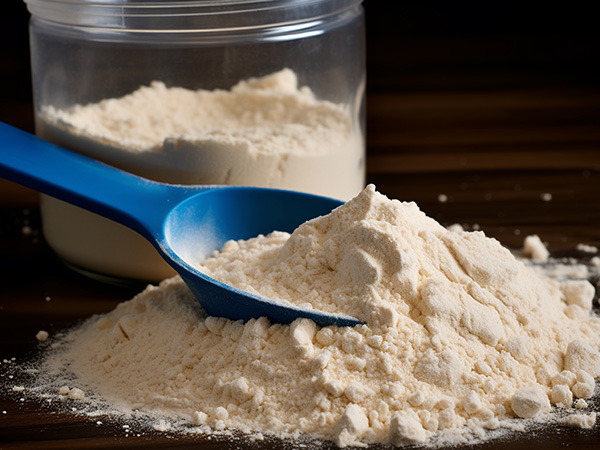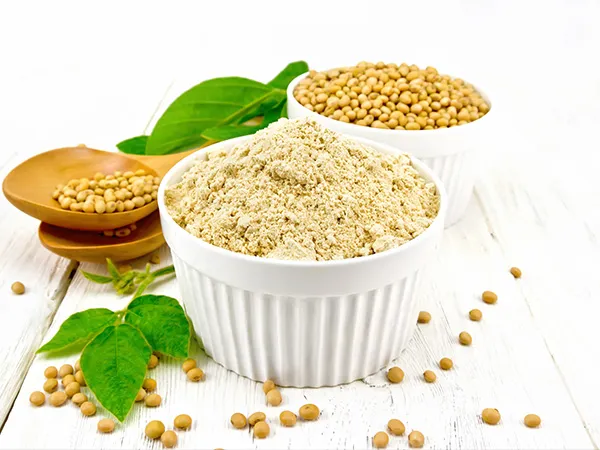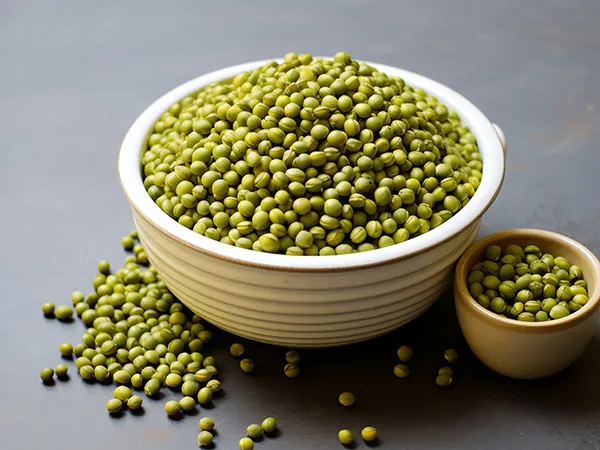
The global demand for plant-based proteins is surging, driven by health-conscious consumers, sustainability goals, and dietary shifts toward vegan, vegetarian, and flexitarian lifestyles. Peas, faba beans, lentils, chickpeas, rice, hemp, and other legumes and seeds serve as key sources for protein isolates, concentrates, and functional ingredients in meat alternatives, beverages, baked goods, and nutritional supplements. Achieving the right particle size—typically in the micron range—is critical for texture, solubility, dispersibility, mouthfeel, and nutritional bioavailability. In this context, Plant-Based Protein Fine Grinding has become a key enabling process for delivering high-performance ingredients.
Among various milling technologies, Air Classifier Mills (ACMs) stand out as superior for fine grinding plant-based proteins. These integrated systems combine impact grinding with dynamic air classification in a single unit, delivering precise particle size control, minimal heat generation, high efficiency, and preserved functionality—advantages that traditional mills like hammer mills, pin mills, or even standalone jet mills often cannot match for these sensitive materials.
Understanding Plant-Based Protein Grinding Challenges
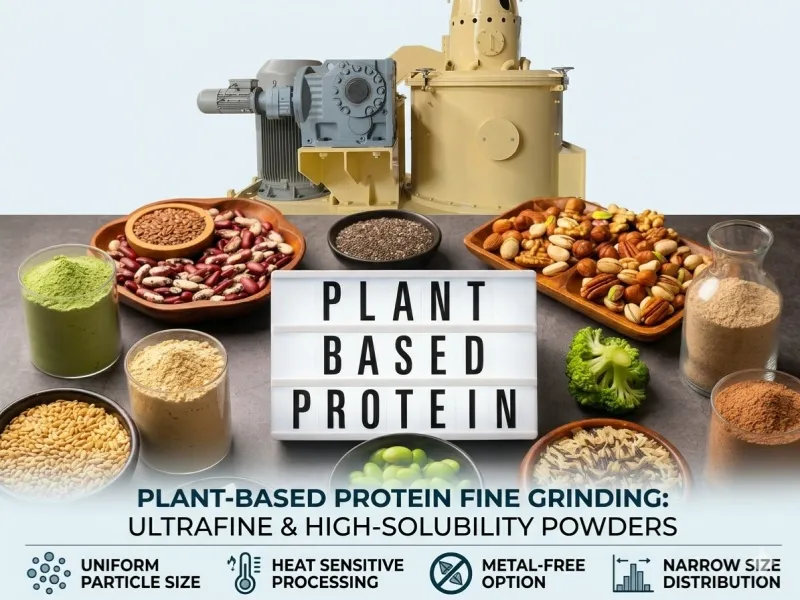
Plant-based proteins present unique milling challenges compared to animal-derived or synthetic materials:
- Heterogeneous Composition: Seeds contain protein bodies, starch granules, fiber, and fats in varying densities and sizes. Proteins are often smaller and lighter than starch, enabling separation via air classification (protein shifting or fractionation).
- Heat Sensitivity: Excessive heat can denature proteins, reducing solubility, emulsification, foaming, and gelation properties essential for food applications. It can also degrade bioactive compounds and cause off-flavors.
- Particle Size Requirements: For optimal functionality, powders often need D50 around 10-20 µm or D90 < 45 µm. Coarser particles lead to grittiness and poor dispersion; over-grinding wastes energy and damages structure.
- Flowability and Agglomeration: Fine proteins can be cohesive and sticky, especially with residual moisture or fats.
- Yield and Purity: Maximizing protein recovery while minimizing waste (e.g., starch-rich fractions) is economically vital.
- Regulatory and Hygiene Standards: Food-grade processing demands easy cleaning, no metal contamination, and compliance with allergen controls.
Traditional hammer mills or pin mills often produce broad particle size distributions (PSDs), generate significant heat through prolonged residence times, and require separate classification steps, leading to inefficiencies—making them less suitable for advanced Plant-Based Protein Fine Grinding applications.
How Air Classifier Mills Work: Principle and Design
An Air Classifier Mill integrates mechanical impact grinding with an internal dynamic air classifier.
Key Components and Process:
- Feed Introduction: Raw or pre-milled material (e.g., dehulled pea flour) enters the grinding chamber via a screw feeder or pneumatic conveyor.
- Impact Grinding: High-speed rotating hammers, pins, or blades (often on a rotor) impact particles against each other, the chamber wall (liner), or a screen. This shatters material into finer particles.
- Airflow and Classification: A powerful fan creates airflow. Particles are carried upward into the classification zone. A rotating classifier wheel (variable speed) generates centrifugal force. Finer/lighter particles (typically protein-rich) overcome drag and exit with the air stream to a cyclone or bag filter. Coarser/heavier particles (starch/fiber-rich) are thrown outward and recirculated for re-grinding.
- Cooling Effect: Continuous air flow dissipates heat rapidly, keeping product temperatures low (often <40-50°C rise).
- Adjustable Parameters: Rotor speed, classifier wheel speed, airflow rate, feed rate, and secondary air (in some designs) allow precise tuning of the cut point (e.g., 5-10 µm for protein shifting).
This closed-loop system ensures narrow PSD, high throughput, and efficiency. Models from manufacturers like Hosokawa Alpine (Mikro ACM), Prater, EPIC, Bradley, and others scale from lab to industrial capacities.
Superior Advantages of Air Classifier Mills for Plant Proteins
1. Precise Particle Size Control and Narrow Distribution
ACMs achieve D97 as fine as 3-20 µm with tight distributions (±5% variation), far superior to hammer mills. This uniformity eliminates grittiness in pea protein isolates and improves solubility and PDI (Protein Dispersibility Index).
2. Heat Management and Nutrient Preservation
Short residence time and convective cooling minimize thermal damage. This retains native protein structure, leading to better functionality (foaming, emulsification, gelation) compared to wet processes or high-heat dry milling. Air classification avoids solvents and drying energy.
3. Integrated Grinding and Classification
One machine handles size reduction and separation, reducing equipment footprint, energy use, and handling steps. For protein shifting, it prepares material perfectly for downstream air classifiers.
4. High Efficiency and Yield in Fractionation
Protein content in pea can rise from ~20-25% to 35-55%+ in fine fractions, with good recovery. Adjustable secondary air improves capture. This dry process is sustainable, with lower water and energy footprints than wet extraction.
5. Versatility Across Plant Sources
Effective for peas, faba beans, lentils, rice, soy, etc.
6. Operational and Economic Benefits
- Easy cleaning and maintenance (CIP options, quick-access designs).
- Energy efficiency for fine grinds.
- Scalability and automation.
- Reduced waste and higher-value co-products (starch/fiber fractions).
7. Improved Product Functionality and Sensory Qualities
Ultra-fine, uniform powders disperse better, hydrate faster, and integrate seamlessly into formulations, enhancing texture in plant-based meats and beverages.
Comparisons with Alternative Technologies
- Vs. Hammer Mills: Hammer mills are simpler and cheaper for coarse grinding but produce wider PSD, more heat, and require external classifiers. ACMs excel in fine, controlled output.
- Vs. Pin Mills or Fine Grinders: Good for intermediate sizes but lack integrated classification for ultra-fine, narrow distributions.
- Vs. Jet Mills: Jet mills achieve even finer sizes (<10 µm) via particle-on-particle collision but have higher energy consumption, lower throughput for some materials, and are costlier for mid-range food applications. ACMs offer better balance for protein work.
- Vs. Wet Processing: Dry ACM routes preserve native functionality, reduce water use, and lower drying costs/environmental impact—making them ideal for Plant-Based Protein Fine Grinding.
Studies show air classification yields concentrates with superior techno-functional properties.
Real-World Applications and Case Studies
Pea protein producers use ACMs to de-agglomerate concentrates and achieve d90 <45 µm for smooth textures. Faba bean processors combine ACM grinding with separate classifiers for enrichment.
A Southeast Asian protein powder factory reportedly boosted yield by 22% and consistency by 15% after upgrading to ACM systems. Research at institutions like the University of Greenwich optimizes ultra-fine classification for better yields and lower carbon footprints in meat substitutes.
Technical Considerations for Optimal Performance
- Material Prep: Pre-milling or dehulling improves feed consistency.
- Parameter Optimization: Classifier speed, air volume, and rotor configuration are tuned per material.
- Wear and Maintenance: Use abrasion-resistant materials for fibrous feeds.
- Safety: Explosion-proof designs for dusty organics; inert gas options.
- Downstream: Pair with cyclones, baghouses, and sometimes additional classifiers for sharp cuts.
Challenges like moisture control or very oily seeds require preconditioning, but modern ACMs handle them well.
Future Trends and Innovations
- Hybrid Systems: ACM + advanced standalone classifiers for sub-10 µm sharpness.
- Energy Optimization: Designs reducing regrinding power for sustainability.
- Smart Controls: AI for real-time PSD monitoring and adjustment.
- Broader Adoption: As plant protein demand grows (projected multi-fold increase), ACMs will be central to efficient, high-quality production.
- Sustainability Focus: Lower emissions via efficient dry fractionation.
Conclusion
Air Classifier Mills are superior for plant-based protein fine grinding because they elegantly solve the core challenges of precision, heat sensitivity, efficiency, and functionality in one robust system. By delivering uniform micron-sized powders with preserved native properties, higher yields, and lower environmental impact, ACMs enable manufacturers to meet rising demand for high-quality, great-tasting, and sustainable plant proteins.
Whether producing pea isolates for burgers, rice protein for beverages, or multi-source blends, investing in ACM technology provides a competitive edge through better products, reduced costs, and future-proof operations. As the industry evolves toward cleaner labels and circular economies, ACMs will remain a cornerstone of dry processing excellence.

“Thanks for reading. I hope my article helps. Please leave a comment down below. You may also contact Zelda online customer representative for any further inquiries.”
— Posted by Emily Chen