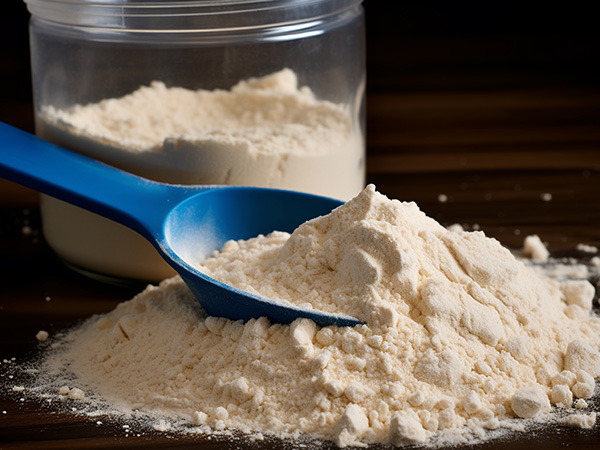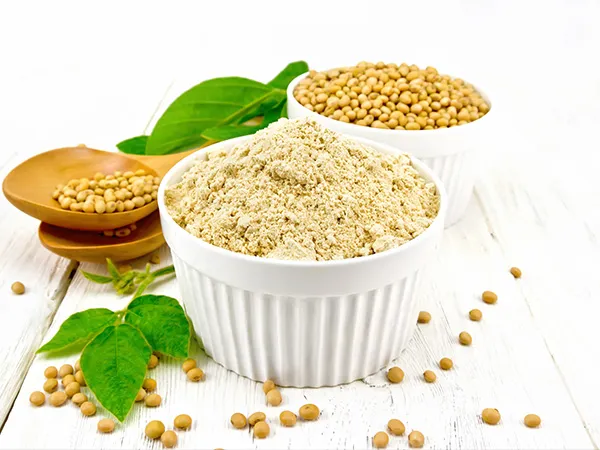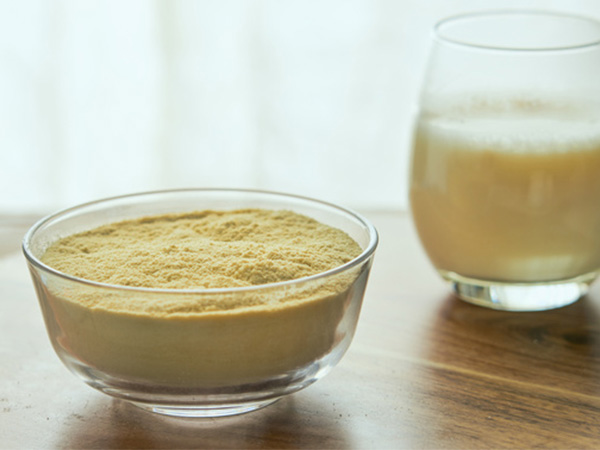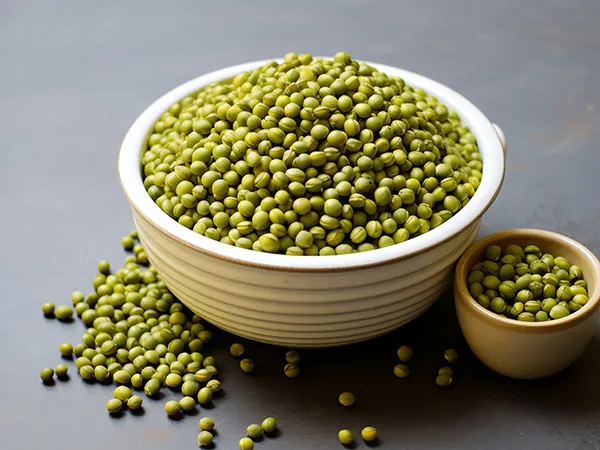
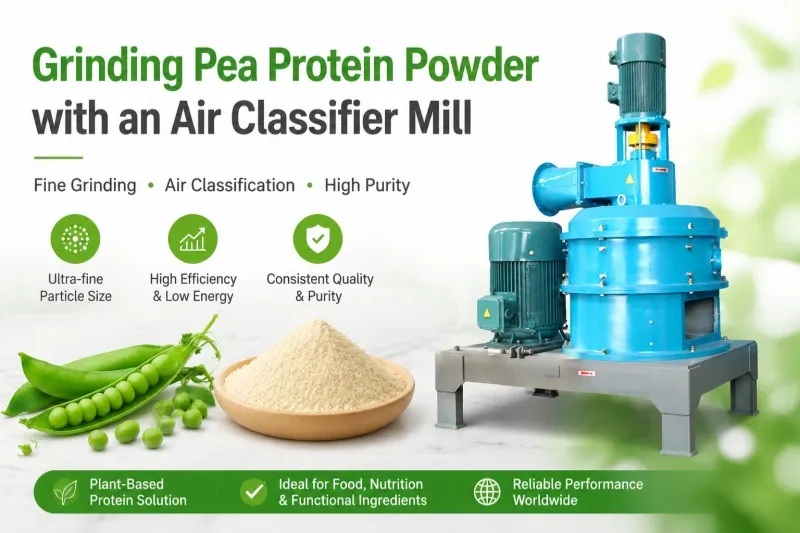
The global food industry is experiencing a massive paradigm shift. Driven by the explosive growth of plant-based proteins, gluten-free diets, and clean-label ingredients, pea flour has emerged as a superstar ingredient. From meat alternatives and protein shakes to allergen-free baked goods, the market demand for high-quality pea flour is skyrocketing.
However, processing raw yellow or green peas into a commercial-grade, ultra-fine powder is a notoriously difficult task for food manufacturers. Peas are not brittle grains like wheat; they are dense, fibrous, and packed with sensitive proteins. Choosing the wrong milling equipment can result in clogged machinery, ruined nutritional profiles, and a gritty, subpar end product.
If your goal is to achieve consistent, high-quality fine pea flour, which industrial grinder should you invest in?
While several options exist, industrial experience proves that the Air Classifier Mill (ACM) reigns supreme as the overall best choice, with the Pin Mill serving as a highly efficient, cost-effective runner-up.
Below, we will break down the science of pea milling, compare the leading industrial grinders, and reveal why specific technologies deliver the ultimate fine-flour results.
Key Challenges in Grinding Peas into Fine Flour
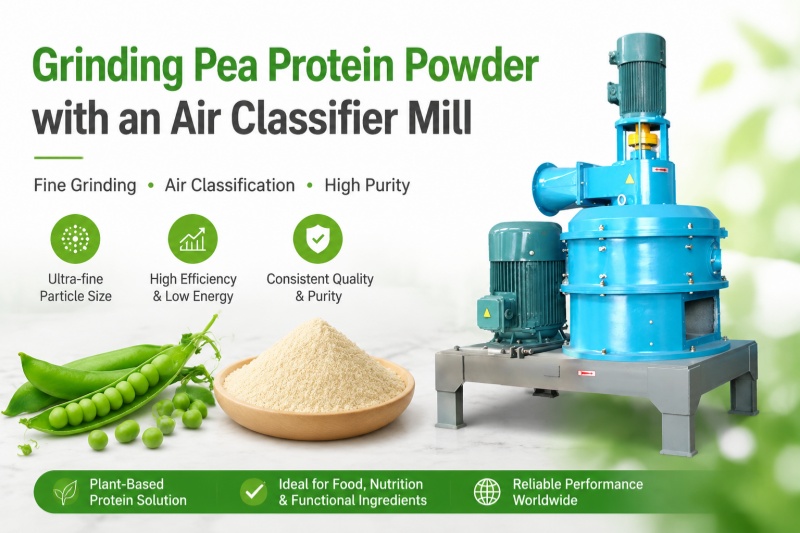
Before evaluating machinery, it is crucial to understand the physical and chemical characteristics of the pea itself. Legumes behave very differently under mechanical stress compared to corn or wheat.
1. High Protein & Heat Sensitivity
Peas contain roughly 20% to 25% protein. When subjected to intense mechanical friction inside a standard grinding chamber, the temperature rises rapidly. If the temperature exceeds critical thresholds (typically around 50°C to 60°C), the proteins begin to denature or “cook.” This alters the flour’s solubility, emulsification properties, and water-binding capacity, rendering it useless for high-end food formulations.
2. The Tough, Fibrous Shell
The outer hull of a pea is incredibly fibrous and resilient. It resists simple impact. If the hull is not pulverized correctly, the resulting flour will contain dark, gritty specks and an uneven texture, heavily degrading the mouthfeel of the final food product.
3. Particle Size Distribution (PSD)
For premium food applications, simply being “fine” is not enough. The flour must have a narrow and uniform Particle Size Distribution. A mix of overly large chunks and microscopic dust creates unpredictability in baking or protein extraction. You need a machine that targets a strict specification—typically between 100 to 325 mesh (150 to 45 microns)—with absolute consistency.
Top Industrial Grinder for Fine Pea Flour
To achieve a true fine or ultra-fine grind, industrial manufacturers generally choose between three primary types of milling systems. Let’s analyze how they perform against the challenges of pea milling.
1. Air Classifier Mill (ACM) —— ★★★★★ (The Gold Standard)
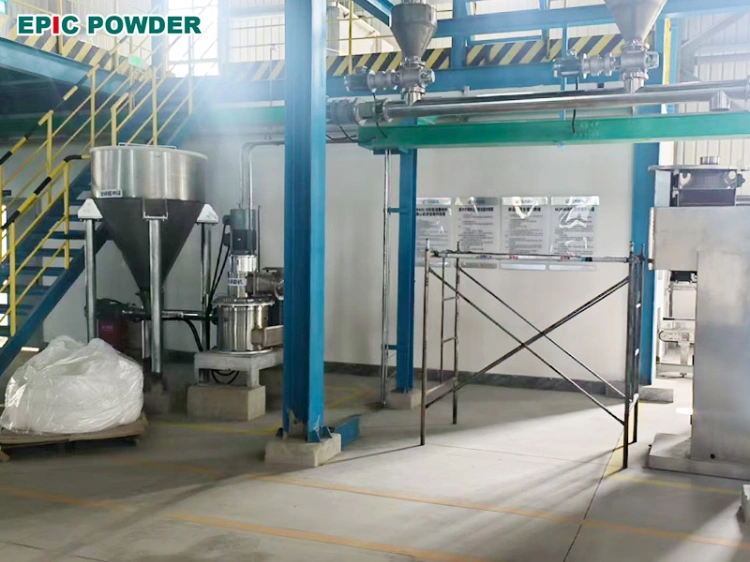
The Air Classifier Mill (ACM) is widely recognized as the ultimate solution for producing ultra-fine pea flour. It is an integrated system that combines high-speed impact milling with an internal dynamic air classification wheel.
- How it Works: Whole or dehulled peas are fed into the grinding chamber, where they are shattered by a high-speed rotor turning against a stationary liner. Simultaneously, a continuous stream of air draws the pulverized particles upward toward a rotating classifying wheel.
- The Precision Mechanism: The classifying wheel acts as a strict gatekeeper. Particles that are small enough pass through the wheel and are collected as the final fine flour. Particles that are too large are rejected by centrifugal force and thrown back down into the grinding zone for further reduction.
- Why it Excels for Pea Flour:
- Built-in Cooling: The massive volume of air moving through the system continuously cools the grinding chamber. This completely eliminates the risk of protein denaturation and thermal degradation.
- Screenless Design: Because it uses an air wheel instead of a physical mesh screen to determine size, there is zero risk of blinding or clogging, allowing for continuous, 24/7 industrial operation.
- Adjustable Fineness on the Fly: Operators can change the target particle size simply by adjusting the RPM of the classifier wheel via a control panel, without needing to stop the machine to swap out parts.
2. Pin Mill (Universal Dynamic Mill) —— ★★★★☆ (High-Yield Alternative)
For operations that require high throughput and excellent fineness but operate on a slightly lower capital investment budget, the Pin Mill is a phenomenal contender.
- How it Works: A pin mill utilizes two interlocking discs studded with metal pins or “projectiles.” Usually, one disc is stationary while the other rotates at extreme speeds (or both rotate in opposite directions). Peas are fed into the center and are sheared, shattered, and smashed as they are flung outward through the maze of spinning pins by centrifugal force.
- Why it Works for Pea Flour: Pin mills exert a massive amount of high-intensity impact and shear in a single pass (one-pass milling). When processing pre-dehulled, dry peas, a pin mill can easily achieve fine flour down to the 100–150 mesh range with an exceptionally high output rate relative to its footprint.
- The Caveat: Pin mills generate more friction heat than ACMs. To prevent the pea flour from baking onto the pins or degrading the protein, they often require an auxiliary conditioned or chilled air-feed system to maintain a safe operating temperature.
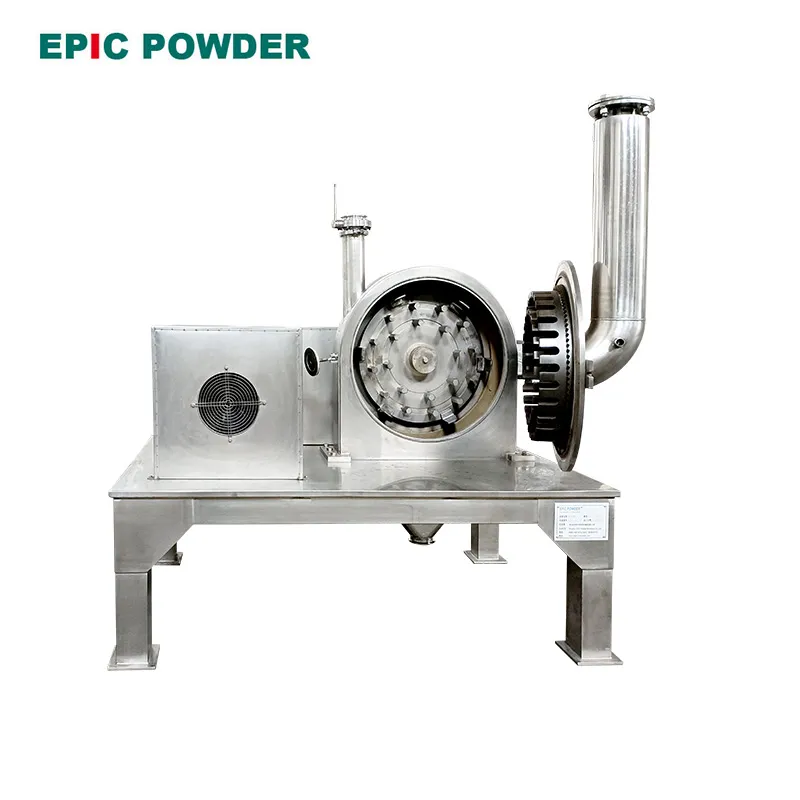
3. Universal Hammer Mill —— ★★☆☆☆ (Suitable for Pre-Crushing Only)
The industrial hammer mill is the workhorse of the agricultural sector, utilizing pivoting metal sticks (hammers) to crush materials against a heavy-duty perforated metal screen.
- Why it Fails for Fine Flour: While highly rugged, hammer mills are completely unsuited for fine food-grade pea flour. To achieve a fine grind, a hammer mill requires a tiny screen mesh. Because peas contain oil and high fiber, these tiny screen holes quickly become blinded (blocked) by a sticky paste.
- The Verdict: Heat builds up immediately, the machine chokes, and production grinds to a halt. A hammer mill should only be utilized at the very front of the processing line to coarsely crack whole peas open before they enter a fine-grinding system.
Crucial Process Steps Before & After Grinding
An industrial pea grinder does not operate in a vacuum. To achieve a premium, market-ready fine pea flour, your milling system must be supported by proper upstream and downstream engineering.
Step 1: Cleaning and Dehulling (Upstream)
Before the peas ever touch the pea grinder, they should pass through a dehuller (peeling machine). The outer hull accounts for a significant portion of the pea’s bitter taste and fibrous grit. Removing the hull yields a flour that is noticeably sweeter, a brighter yellow/green color, and significantly smoother on the palate. Furthermore, removing the abrasive hulls extends the lifespan of your grinder’s internal components.
Step 2: Grinding and Conditioning
This is where your ACM or Pin Mill does the heavy lifting, reducing the dehulled peas into an ultra-fine powder while protecting the starch and protein matrices via strict temperature control.
Step 3: Safety Screening and Packaging (Downstream)
Even with an Air Classifier Mill, a downstream Vibratory Sifter (Gyrosifter) is standard practice for quality assurance. It acts as a final safety check, catching any accidental foreign debris or agglomerated clumps before the fine flour flows into bulk bags or retail packaging lines.
Conclusion
When configuring a processing plant for fine pea flour, cutting corners on the grinding technology will inevitably lead to operational bottlenecks and inferior product quality.
If your business prioritizes premium quality, strict particle uniformity, and maximum protein preservation, the Air Classifier Mill (ACM) is unquestionably the best industrial pea grinder for the job. It handles the sticky, heat-sensitive nature of legumes flawlessly. However, if your facility demands high-volume output with straightforward maintenance and lower upfront capital expenses, a Pin Mill equipped with a cooling air auxiliary system represents an incredibly capable and efficient alternative.
People Also Ask (FAQ)
Q1: Can we use a standard industrial hammer mill to produce edible fine pea flour?
A: While a standard industrial hammer mill is excellent for coarse milling or animal feed, it is not recommended for producing high-quality edible fine pea flour. Hammer mills rely on internal physical screens to control particle size. When attempting to achieve a fine mesh (e.g., above 100 mesh), the high fiber and protein content of peas quickly clogs the screen openings (known as screen blinding). Furthermore, the prolonged mechanical friction generates intense heat that can easily degrade or denature the pea protein, altering its flavor, solubility, and nutritional value. For food-grade fine flour, an Air Classifier Mill or Pin Mill is far superior.
Q2: Why is moisture control critical before feeding peas into an industrial grinder?
A: Moisture control is the backbone of efficient legume milling. Ideally, the raw peas should maintain a strict moisture content of around 12% to 14% before entering the pea grinder.
- If the moisture is too high (>15%): The peas become elastic and gummy rather than brittle. This causes them to pastify inside the grinding chamber, sticking to the rotors, choking the mill, and heavily reducing throughput.
- If the moisture is too low (<10%): The peas become overly brittle. The starch granules may fracture too aggressively under impact, increasing “damaged starch.” Excessively damaged starch absorbs water unpredictably, which negatively impacts the flour’s baking stability and water-binding capacity in food applications. Proper drying and tempering ensure the peas shatter cleanly into fine powder without structural ruin.

“Thanks for reading. I hope my article helps. Please leave a comment down below. You may also contact Zelda online customer representative for any further inquiries.”
— Jason Wang, Engineer