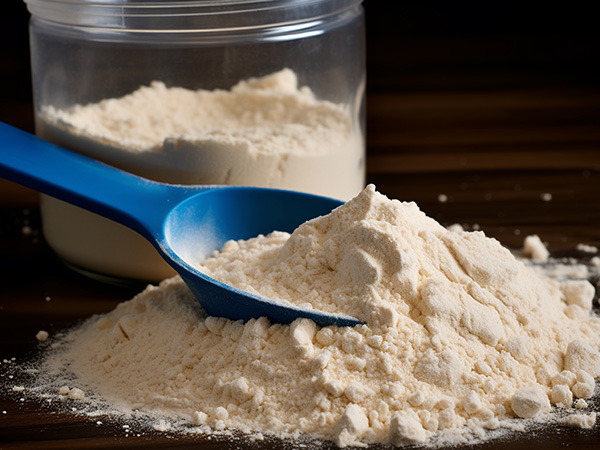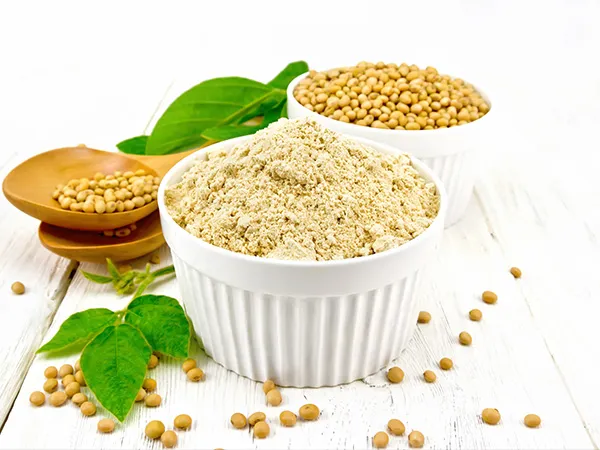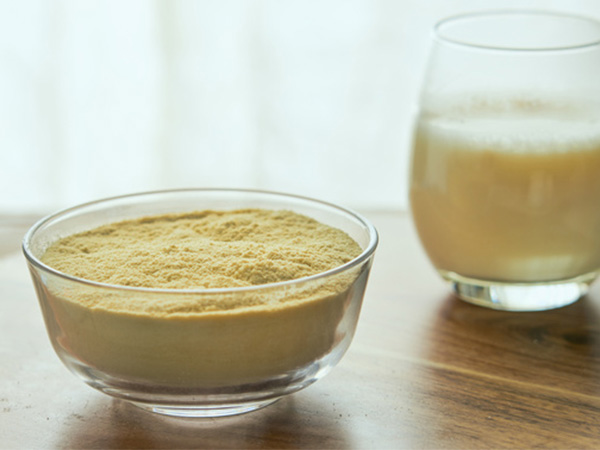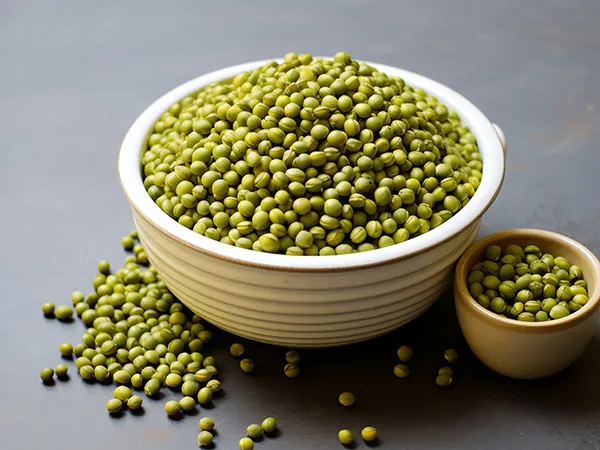
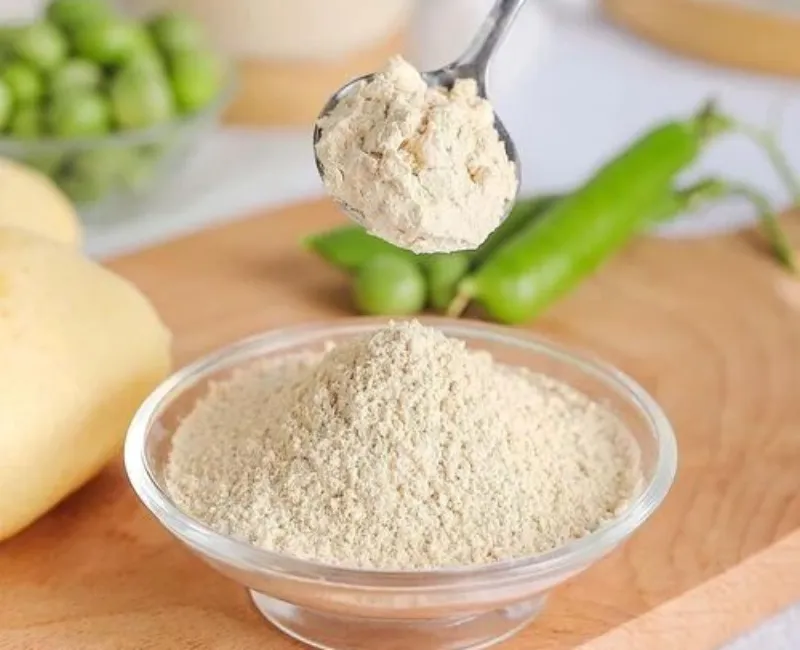
The global shift toward plant-based diets has catapulted pea protein into the spotlight. Pea protein powder is derived from yellow peas (Pisum sativum). Today, it is a dominant ingredient in sports nutrition, meal replacements, and functional foods. Its popularity is well-deserved for three main reasons. First, it boasts an excellent amino acid profile rich in branched-chain amino acids. Second, it exhibits low allergenicity compared to soy or dairy. Finally, it carries a highly desirable clean consumer label.
However, extracting and processing plant proteins while preserving their native biological value is a delicate science. In modern industrial processing, dry fractionation via an Air Classifier Mill (ACM) has emerged as the premier method for manufacturing clean-label pea protein concentrates. Unlike wet chemical extraction, dry fractionation preserves the protein’s native state without using chemical solvents or massive amounts of water.
The primary engineering challenge during this mechanical reduction is heat. High-speed milling inherently generates friction. This excessive thermal exposure can denature the protein and destroy essential amino acids. Consequently, it ruins the solubility and foaming properties of the final powder. This comprehensive guide explores the structural mechanics of pea protein processing and provides actionable technical strategies to maintain peak nutrient quality when utilizing an Air Classifier Mill.
1. The Vulnerability of Pea Protein: Why Thermal Control Matters
To successfully process pea protein, one must understand how mechanical energy interacts with plant biochemistry.
The Threat of Protein Denaturation
Proteins are complex, three-dimensional molecular structures held together by hydrogen bonds, disulfide bridges, and hydrophobic interactions. When pea flour is subjected to high temperatures inside a milling chamber, these delicate bonds rupture. This structural unfolding is known as denaturation.
While intentional denaturation occurs during cooking, unintentional denaturation during industrial grinding severely compromises the functional properties of the powder:
- Reduced Solubility: Denatured proteins lose their ability to disperse evenly in water, resulting in a gritty texture in consumer protein shakes.
- Loss of Emulsification and Foaming: Native pea protein acts as an excellent emulsifier in food formulations. Heat-damaged protein loses its surface-active properties, rendering it useless for applications like plant-based meats or dairy alternatives.
- Destruction of Thermolabile Nutrients: Beyond the macro-protein structure, peas contain vitamins (specifically B-vitamins) and bioactive peptides that are highly sensitive to heat. Ambient temperatures exceeding 50°C to 60°C during grinding accelerate the degradation of these vital micro-nutrients.
The Mechanics of the “Protein Shift”
Pea flour consists primarily of two components. The first is heavy, dense starch granules, ranging from 20μm to 40μm in size. The second is lighter, smaller protein matrices (1μm to 10μm) that adhere to the starch. To separate them, the Air Classifier Mill applies precise mechanical impact. This process breaks the bond between the protein and the starch through deagglomeration. Crucially, it does so without shattering the larger starch granules into ultra-fine dust.
If the mill runs too hot or too aggressively, the starch fractures. This fragmentation makes it aerodynamically impossible for the air classifier to separate the protein from the starch. This lowers both the final protein purity and the overall yield.
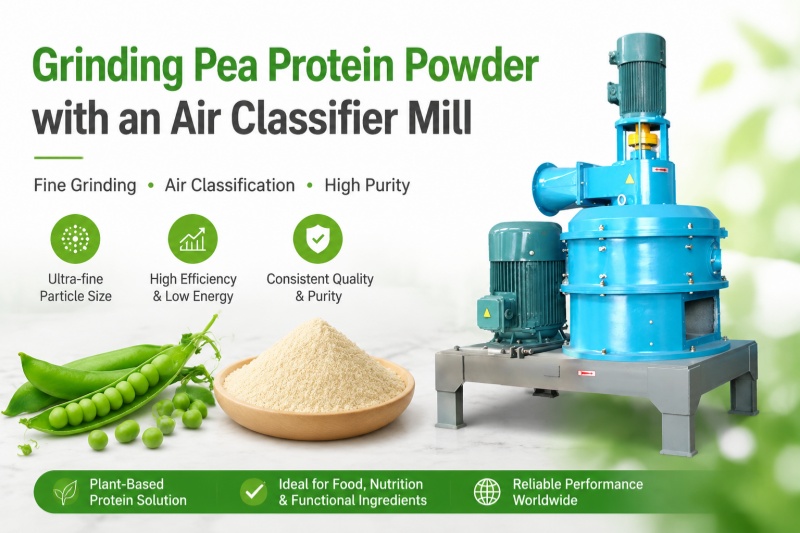
2. Anatomy of an Air Classifier Mill in Pea Protein Powder Processing
The Air Classifier Mill is uniquely suited for pea protein processing because it combines fine impact milling with integrated dynamic air classification within a single, continuous system.
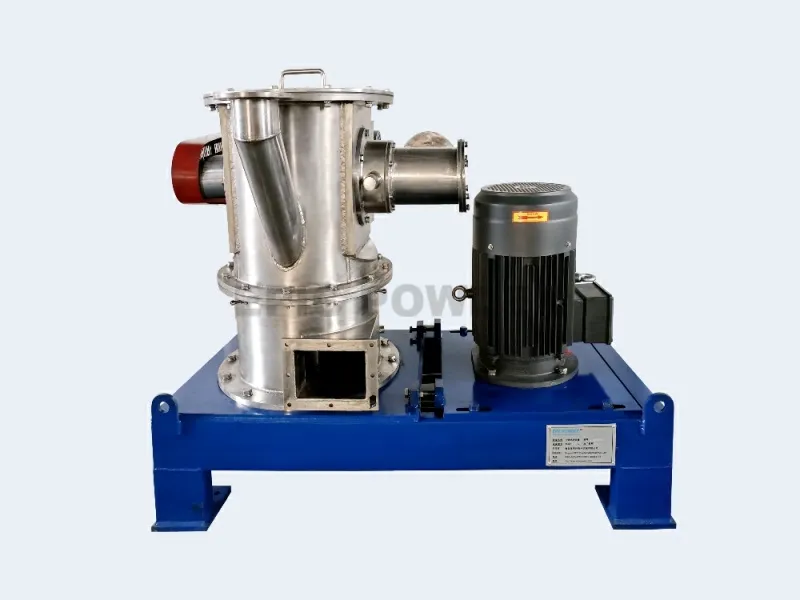
An industrial ACM setup optimized for plant protein dry fractionation consists of the following core components:
- The Grinding Rotor: Equipped with high-speed pins, hammers, or beaters. It spins at high linear speeds, generating the impact forces required to detach the fine protein matrix from the larger starch granules.
- The Classifying Wheel: Positioned above or adjacent to the grinding chamber. This independently driven wheel acts as a precise physical barrier. It rotates rapidly and uses centrifugal force to reject heavy, starch-rich particles. Meanwhile, it allows the lightweight, fine protein particles to pass through.
- The Process Air Stream: A high-volume fan draws air through the bottom of the mill to carry the pulverized particles upward toward the classifier. This single air stream performs a critical double duty. It simultaneously transports the material and acts as the primary cooling medium for the system.
3. Step-by-Step Strategies to Preserve Nutrient Quality
Maintaining nutrient integrity requires a holistic approach that manages heat, retention time, and air handling across the entire milling circuit.
[Raw Pea Flour Feed]
       ⬇
[Chilled Intake Air (10-15°C)] ➔ [Air Classifier Mill (ACM)] ➔ [Cyclone Collector] ➔ [Final Product]
                                       ⬇
                       [Optimized Tip Speed & Short Retention]
Step 1: Implement Cool-Air Feed Technology (Chilled Process Air)
The most direct way to combat frictional heat inside the ACM is to manipulate the temperature of the intake process air.
- The Principle: As the grinding rotor spins, the mechanical energy transferred to the material raises the internal chamber temperature. If the intake air is pulled directly from a warm factory floor (e.g., 25°C to 30°C), the internal temperature can easily spike past 60°C.
- The Solution: Integrate an air-cooling heat exchanger (chiller) at the primary air intake. Dehumidifying and chilling the incoming process air to between 10°C ~ 15°C creates a thermal buffer. This ensures that even after absorbing mechanical friction heat, the exit temperature of the pea protein powder remains safely below 40°C, well beneath the thermal denaturation threshold of plant proteins.
Step 2: Optimize Rotor Tip Speed and Impact Geometry
To avoid over-milling and heat generation, operators must balance the rotor’s tip speed with the physical properties of the pea aggregate.
- Avoid Over-Milling: Running the grinding rotor at maximum velocity creates excessive micro-collisions. This action generates immense thermal energy. At the same time, it unintentionally pulverizes the starch granules into the same micron range as the protein.
- The Calibration: For pea protein dry fractionation, the rotor tip speed should be carefully calibrated (typically between 60m/s ~ 90m/s, depending on mill diameter). The goal is to achieve selective comminution—shattering the fragile protein matrices free while leaving the rugged starch granules intact.
- Smooth Blade Geometry: Utilizing rounded or smooth-faced grinding hammers rather than sharp, serrated beaters reduces frictional drag within the air-powder vortex, minimizing localized heat pockets.
Step 3: Accelerate Material Retention Time
The longer a protein particle stays inside the hot grinding zone of a mill, the higher the likelihood of thermal damage. Minimize retention time using a high air-to-material ratio.
- Pneumatic Efficiency: Always ensure the system fan provides a high volume of airflow relative to the product feed rate. This setup maintains a high Air-to-Material ratio. The resulting strong, consistent pneumatic pull sweeps the detached protein particles out of the grinding zone. Consequently, particles pass through the classifying wheel within fractions of a second.
- Preventing Internal Recirculation: If the air classifier wheel is set to an excessively aggressive cut point, it will continuously reject borderline particles back into the grinding chamber. This creates a bottleneck, increasing the internal temperature. The system must be fine-tuned so that qualified fine protein is evacuated instantly.
Step 4: Control Feed Moisture and Flow Stability
The moisture level of the raw split peas or pea flour entering the ACM dictates how the material behaves under mechanical stress.
- Target Moisture Range: The ideal moisture content for pea flour entering an ACM is between 8% and 10%.
- The Danger of Excess Moisture: If the moisture exceeds 12%, the pea flour becomes sticky and elastic.The moist particles absorb the impact energy instead of shattering cleanly. This response increases friction and builds up heat. As a result, the sticky powder cakes onto the rotor and classifying wheel.
- The Danger of Over-Drying: If the peas are over-dried (below 6%), the protein matrices become brittle and shatter indiscriminately alongside the starch, ruining the separation efficiency of the downstream air classification step.
4. Measuring Quality: Post-Milling Evaluation
To confirm that your ACM settings are successfully preserving the nutritional and structural integrity of the pea protein, the finished powder must undergo routine quality assurance testing.
Protein Purity (D90 Classification)
Using a laser diffraction particle size analyzer, verify that your protein fraction features a highly narrow particle size distribution, typically with a top cut (D90) around 10 ~ 65 μm. A precise cut confirms that the starch has been successfully excluded from the protein stream without excessive shattering.
Nitrogen Solubility Index (NSI)
The NSI is the definitive laboratory test for monitoring protein denaturation.
- How it Works: Native, undamaged pea protein exhibits high solubility in water at specific pH levels. If the ACM setup is running too hot, the NSI percentage will drop significantly compared to the raw feed material.
- The Target: Maintaining an NSI value close to the baseline material proves that the milling process kept the proteins in their highly functional, native state.
Color and Ash Analysis
- Color Uniformity: Heat-damaged plant protein undergoes a subtle Maillard (browning) reaction, shifting from a bright, creamy light-yellow to a dull, darkened tan. Automated whiteness and color meters ensure batch-to-batch consistency.
- Ash/Fat Content: Monitoring lipid levels in the fine fraction is important, as liberated lipids can cause oxidation and rancidity if exposed to high operational temperatures inside the mill.
5. Summary Checklist for Factory Operators
For production managers running an Air Classifier Mill line for pea protein processing, keep this optimization checklist on the plant floor:
| Parameter | Operational Target | Reason for Optimization |
| Intake Air Temperature | 10°C – 15°C (Chilled) | Counteracts mechanical heat; keeps exit powder below 40°C. |
| Feed Moisture Content | 8% – 10% | Prevents material stickiness, reduces friction, and ensures clean deagglomeration. |
| Rotor Tip Speed | Balanced (60 – 90m/s) | Maximizes protein detachment while preventing starch fracturing. |
| Air System Status | Continuous Negative Pressure | Prevents dust escape, cools the chamber, and ensures rapid material evacuation. |
| Sanitation Cycle | Frequent Dry-Cleaning | Prevents fine protein buildup on blades, which can scorch over time. |
Conclusion
The Air Classifier Mill is an incredibly powerful tool for the clean-label production of pea protein powder via dry fractionation. However, maximizing its potential requires shifting focus from raw mechanical throughput to precise thermodynamic control.
Processors can eliminate the risk of thermal denaturation through three key steps. First, implement chilled process air. Second, optimize rotor speeds to prevent starch fracturing. Finally, keep material retention times to an absolute minimum. This careful balance of engineering and biochemistry protects the final product. It ensures that the pea protein powder retains its superior solubility, nutritional density, and functional value. Ultimately, this process delivers a premium ingredient that meets the strict demands of today’s health-conscious global market.

“Thanks for reading. I hope my article helps. Please leave a comment down below. You may also contact Zelda online customer representative for any further inquiries.”
— Posted by Emily Chen