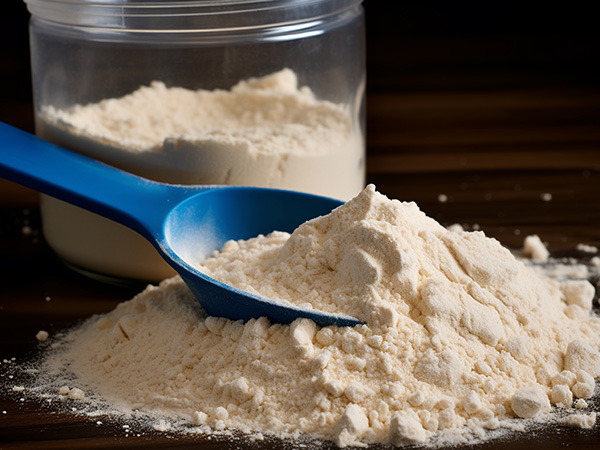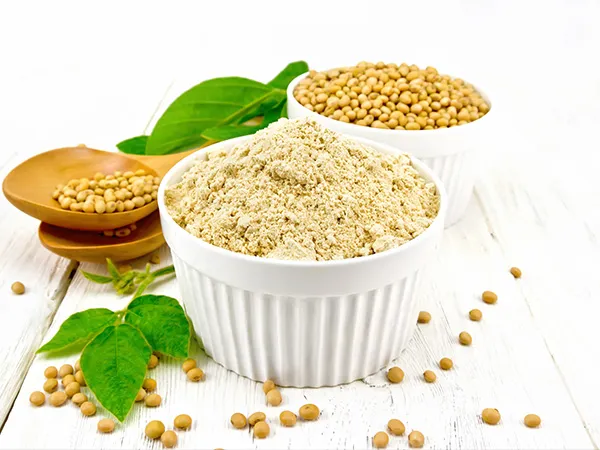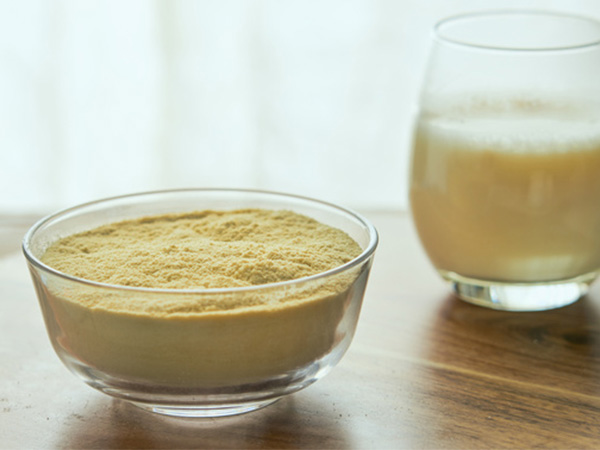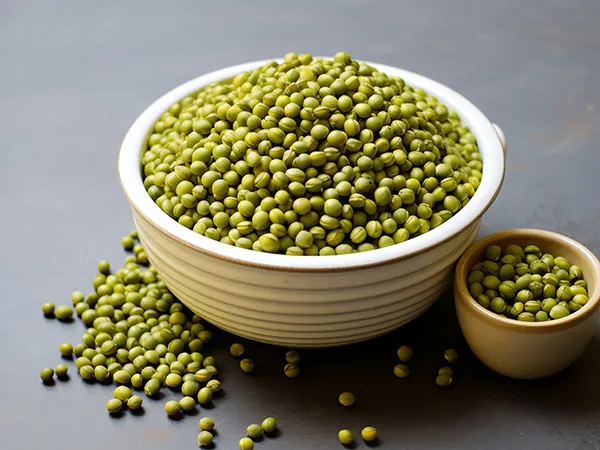
The global plant-based food market is experiencing explosive growth. Pea protein is highly sought after in the food industry due to its unique benefits: it is allergen-free, highly digestible, amino-acid balanced, and environmentally sustainable. For manufacturers, the core objectives are to reduce energy consumption and improve processing efficiency while producing high-purity, high-yield protein powder.
Traditional wet extraction processes yield protein with high purity, but their shortcomings are significant. For example, they consume large amounts of water, leave chemical residue, incur high wastewater treatment costs, and are prone to damaging the protein’s natural structure.
To solve this, dry enrichment via Air Classifier Mills (ACM) introduces a game-changing, purely physical method. It operates with zero wastewater and fully preserves natural protein activity, offering a novel path to superior yield and quality.
TThis article explores how to optimize ACM processing to maximize your pea protein powder yield.
The Central Role of Air Classifier Mills in the Dry Separation of Peas
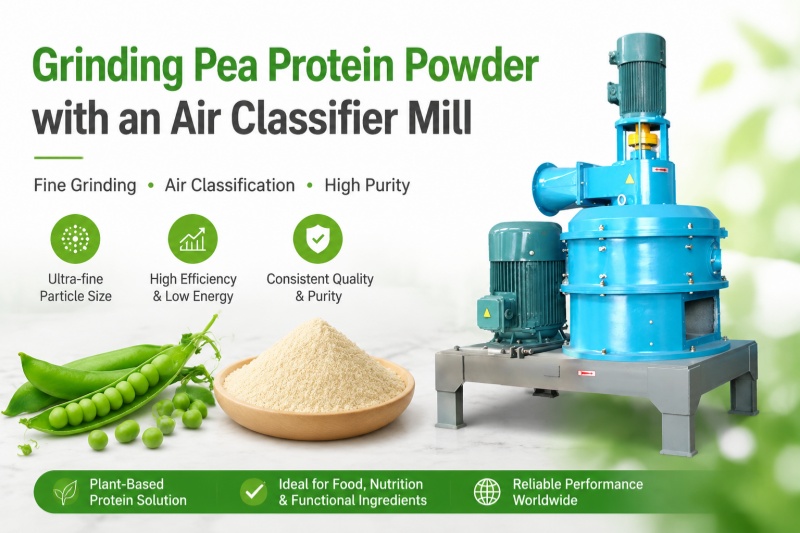
To understand how to increase yield, it is first necessary to understand the microstructure of peas and the operating principles of air-classifying mills.
Peas consist primarily of starch granules surrounded by a protein matrix. Starch granules are relatively large (typically between 20 μm and 40 μm). Protein fragments are extremely small (typically less than 3 μm to 5 μm).
The core principle of dry separation is to dissociate proteins from starch through precision grinding. The two components are then separated using an air stream based on differences in particle density and size.
The air-classifying mill combines “ultrafine grinding” and “precise classification” into a single process:
Mechanical Impact Grinding: Once pea protein powder enters the grinding chamber, it is subjected to intense impact, shearing, and collision from high-speed rotating hammers or blades, resulting in rapid grinding.
Air Classification and Separation: The ground material enters the classification zone under the suction force of the blower. The built-in high-speed classifier wheel generates powerful centrifugal force, while the system’s air network creates centripetal suction. Lighter, finer protein particles overcome the centrifugal force, pass through the classifier wheel with the airflow, and enter the collection system (enriched as high-protein powder). Heavier, coarser starch particles are flung back by the classifier wheel to the grinding zone for re-grinding or discharged through the discharge port (enriched as starch powder).
Five Key Strategies for Increasing Pea Protein Powder Yield Using Air Classifier Mills
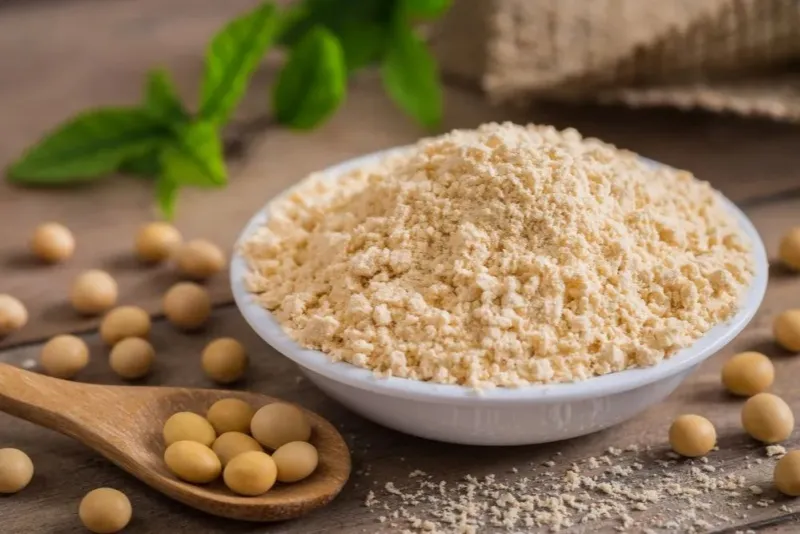
To maximize the yield (output and enrichment efficiency) of pea protein powder, it is essential to finely adjust the process parameters, material conditions, and system configuration of the production line.
1. Strictly Control the Moisture and oOil Content of the Feed Material
The physical properties of the material directly affect the efficiency of crushing and classification. The moisture content of shelled peas should be strictly controlled between 10% and 12%. Excessive moisture: The material becomes more resilient, making it difficult to crush by impact. Furthermore, it tends to adhere inside the grinding chamber, clogging the screens or classification wheels, which leads to interruptions in production continuity and a significant drop in output.
Moderate drying: This increases the material’s brittleness, making it easier for the protein matrix to peel away from the surface of the starch granules. This achieves “precise dissociation,” thereby increasing the hourly output per machine.
2. Optimizing the “Golden Ratio” Between the Grinding Disc Speed and the Classifier Wheel Speed
The key to increasing yield lies in balancing the degree of disintegration with separation accuracy.
Grinding disc speed: The speed determines the intensity of the grinding process. It should be adjusted to a level that just separates the protein from the starch without crushing the starch granules. If the starch granules are over-ground (become too fine), they will mix with the protein. This prevents the classifier wheel from effectively separating them, thereby reducing the purity and recovery rate of the protein powder.
Classifier wheel speed: The classifier wheel speed determines the cut size (d50). For pea protein, the classifier wheel speed is typically set to a higher range to ensure that d50 is maintained below 15 μm. This allows fine protein particles to pass through quickly, enabling continuous, efficient, high-yield output.
3. Optimizing System Airflow and Gas-to-Solid Ratio
Air-classifying mills are systems that use air as a carrier. The total system airflow is responsible not only for transporting the material but also for cooling the grinding chamber and performing classification and screening.
Increasing airflow: This accelerates the passage of qualified fine powder (protein powder) through the classifier wheel and reduces over-grinding within the grinding chamber. This directly increases output per unit of time.
Optimal air-to-solid ratio: The feed rate must be precisely matched to the airflow. Excessive feeding can lead to an imbalance of “too much air and too little material” or “too much material and too little air” within the system, causing turbulent airflow and reducing classification efficiency. Maintaining a constant air-to-solid ratio through a variable-frequency automated feeding system is the foundation for stable and high production.
4. Wear-Resistant and Anti-Adhesive Design
Plant proteins possess a certain degree of stickiness and hygroscopicity. During high-speed grinding, localized temperature increases can cause the proteins to soften and adhere to the inner walls of the grinding chamber and the blades of the classifier wheel.
Select liners that have undergone surface polishing and anti-adhesive coating treatment.
Regularly clean the classifier wheels with reverse airflow to prevent scaling on the blades, which can cause dynamic imbalance and reduce classification efficiency. This ensures the equipment can operate continuously under high loads for 24 hours, thereby increasing overall production.
5. Implementation of Closed-Loop or Multi-Stage Classification Systems
A single classification pass often fails to fully extract all protein. To maximize yield, processing plants typically employ two-stage or multi-stage air classification systems. The first stage removes most of the coarse starch, while the protein-rich fine powder enters the second-stage air classifier for further refinement. This combined process thoroughly extracts the protein content from the peas, maximizing total yield.
Q&A (FAQ)
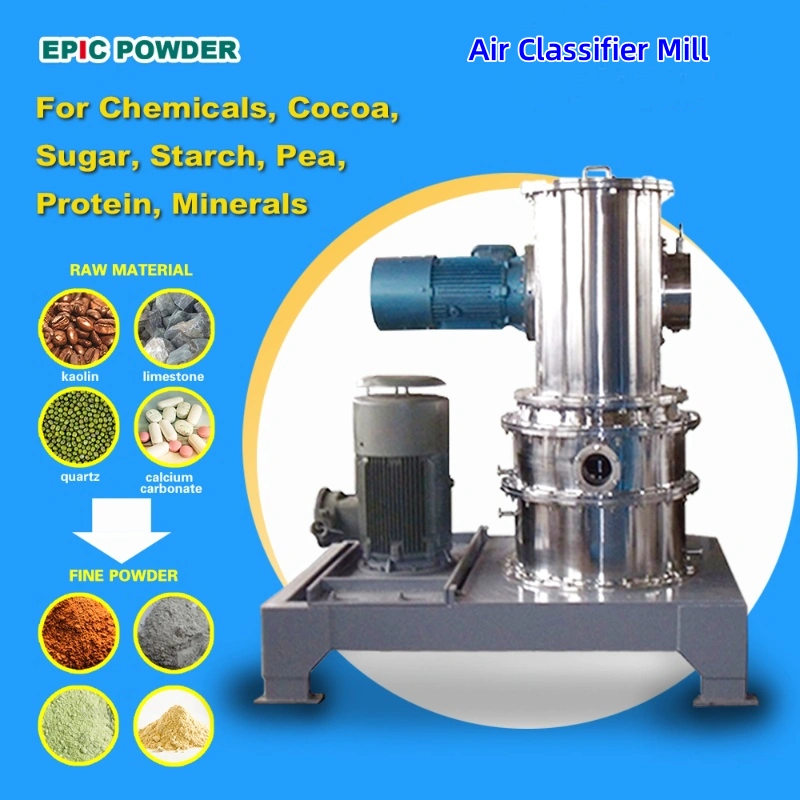
In actual production, operators often encounter various challenges that affect output and process balance. Below are in-depth answers to two of the most common questions.
Question 1: To achieve higher protein powder output, is it acceptable to blindly increase the feed rate? If not, what are the consequences?
Answer:
Under no circumstances should the feed rate be increased indiscriminately. In an air-classifying mill, the relationship between output and feed rate follows an inverted U-shaped curve; it is not a linear positive correlation. Overfeeding not only fails to increase output but also causes the efficiency of the entire production line to collapse. The specific reasons are as follows:
- Airflow blockage and excessive concentration
- Decline in Both Purity and Output
- System transient overload
Correct Approach:
The feeder speed should be automatically adjusted via current feedback. Maintain the main motor current within the optimal load range of 80%–85% of the rated current; at this point, the mill’s output efficiency and equipment stability reach their optimal balance.
Question 2: Air-classifying mills generate significant heat during high-speed operation. How does this affect pea protein powder yield? How should this be addressed?
Answer:
Heat is the “silent killer” in dry-processed plant protein production. Mechanical impact and airflow shear generate significant frictional heat within the grinding chamber.
This causes the internal system temperature to rise (sometimes reaching 50°C–60°C or higher). This has a dual negative impact on both yield and quality:
- Material adhesion and blockages reduce output
- Protein denaturation and loss of value
Systemic Solutions:
Install a cold air source system (refrigeration unit): This is the most effective measure. This is the most effective measure. Install an air cooling system upstream of the induced draft fan inlet. Pre-cool the air injected into the grinding chamber to 5°C–10°C. Use the cold air to counteract mechanical heat generation, maintaining the overall operating temperature within the grinding chamber below 30°C–35°C.
Water-Cooled Jacket Design for the Grinding Chamber:
Select an air-classifying mill equipped with a water-cooled jacket. Circulating cooling water is passed through the outer walls of the grinding and classifying chambers to forcibly conduct and remove heat from the equipment.
Increase System Airflow:
Within the limits permitted by the process, appropriately increase the fan power. Rapid air circulation expels heat from the system along with the air, achieving an “air-cooling” effect.
Conclusion
Using an air-classifying mill to increase pea protein powder yield is a systematic engineering endeavor. It involves multiple aspects, including material properties, mechanical parameters, aerodynamics, and the coordination of various processes.
During production, the moisture content of the material must be maintained within the optimal brittle range. Simultaneously, the speed ratio between grinding and separation must be precisely adjusted, and a reasonable air-to-solid concentration must be maintained. To minimize material adhesion, the process can be supplemented with cold air cooling and sophisticated anti-adhesion designs.

“Thanks for reading. I hope my article helps. Please leave a comment down below. You may also contact Zelda online customer representative for any further inquiries.”
— Posted by Emily Chen