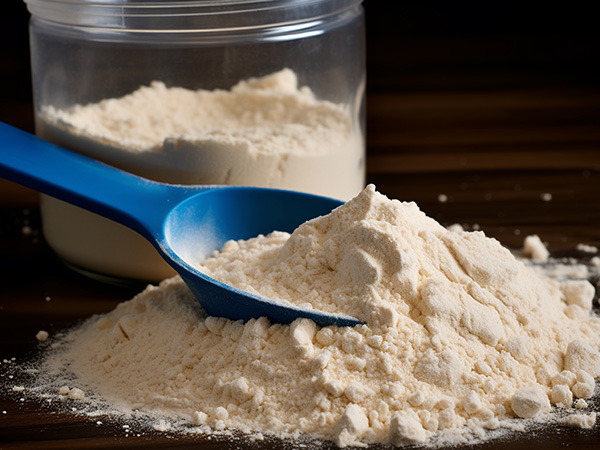
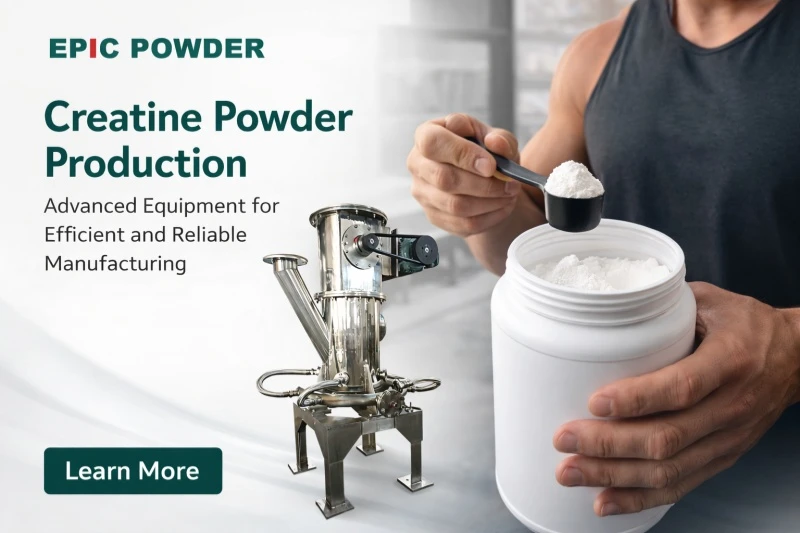
In the field of nutritional supplements and functional foods, creatine (usually referring to creatine monohydrate) is one of the most popular sports supplements. It can significantly improve muscle strength, endurance, and recovery performance.
However, ordinary creatine powder has relatively large particles, typically tens of microns or more. Its solubility is poor, it tends to clump and settle in water, and its absorption efficiency is therefore limited. To address these issues, the industry commonly adopts micronization (ultrafine grinding) technology. This process reduces the particle size of creatine to a few microns or even to the sub-micron level, significantly improving dispersion and bioavailability.
Among the available micronization methods, the jet mill—also known as an air jet mill or fluidized bed opposed jet mill—is widely recognized as the optimal choice.
Brief Overview of Jet Mill Working Principle
Jet milling is a mechanical-contact-free dry ultrafine grinding technology. Jet milling uses high-pressure compressed air (or nitrogen or steam) to generate supersonic gas streams through specially designed nozzles. Under these conditions, material particles collide, rub, and undergo intense shear at extremely high speeds within the airflow, achieving effective pulverization without mechanical contact. After grinding, fine particles are separated by a built-in dynamic classifier and discharged as finished product. Coarse particles are automatically returned to the grinding zone for further size reduction, forming a closed-loop system.
Why Jet Mill Is Particularly Suitable for Ultrafine Grinding of Creatine
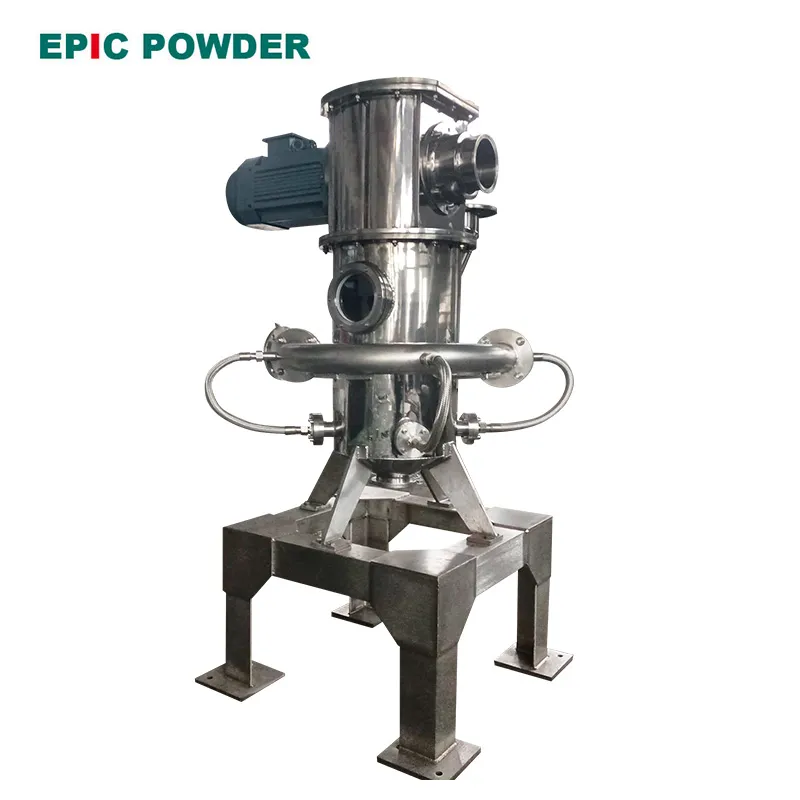
Compared with other mechanical grinding methods (such as ball milling, hammer milling, pin milling, etc.), jet milling shows overwhelming advantages when processing creatine, especially in producing nutritional-grade creatine that pursues ultrafine particle size (d50 ≤ 5–10 μm), high purity, and high bioavailability.
Achieves Extremely Fine Particle Size with Narrow Distribution
Jet mills can easily reduce creatine to 1–10 μm (even sub-micron level), far exceeding the limits of ordinary mechanical mills (usually above 20 μm). Ultrafine particles dramatically increase specific surface area, significantly improving dissolution rate and solubility in the gastrointestinal tract, with almost no residue and reduced gastrointestinal discomfort.
No Mechanical Contact, Virtually Zero Contamination
Traditional mechanical mills rely on direct friction between grinding media (steel balls, ceramic balls) or blades and the material, easily introducing metal, ceramic, or other impurities. Jet milling relies entirely on particle-to-particle collision, with no moving parts inside the grinding chamber — ideal for food-grade/nutritional supplement-grade high-purity requirements. Since creatine is a daily consumed product, even trace amounts of heavy metals or foreign matter can pose cumulative risks. Jet milling minimizes this risk to the lowest level.
Low-Temperature Grinding, Protects Heat-Sensitive Components
Creatine monohydrate can easily dehydrate or degrade at high temperatures (converting to ineffective creatinine, etc.). Jet milling uses the cooling effect from the expansion of high-speed airflow, keeping the grinding chamber temperature at room temperature or even lower, far superior to the noticeable temperature rise produced by mechanical mills.
More Regular Particle Shape and Better Dispersibility
Jet-milled creatine particles have smoother surfaces, fewer sharp edges, and are closer to spherical (compared to the flaky or irregular shapes from mechanical milling), further improving flowability, mixability, and mouthfeel. The high praise for “micronized creatine” in the market is largely due to these superior particle characteristics.
Narrow Particle Size Distribution (PSD) and High Batch-to-Batch Consistency
The built-in high-precision dynamic classifying wheel strictly controls the particle size range, avoiding the coexistence of oversized or ultrafine particles. This is critical for batch stability, dissolution performance, and consistent absorption of creatine products — a core quality factor for premium brands.
Comparison Table with Other Grinding Methods
| Characteristic | Jet Mill | Mechanical Mills (Ball Mill / Pin Mill, etc.) | Advantage Summary |
|---|---|---|---|
| Final Particle Size (d50) | 1–10 μm (sub-micron possible) | Generally 20–50 μm or higher | Finer → better dissolution & absorption |
| Contamination Risk | Extremely low (no contact) | Medium to high (media wear) | Much safer for food/nutraceuticals |
| Temperature Rise | Extremely low or cooling | Noticeable heating | Protects heat-sensitive ingredients |
| Particle Size Distribution Width | Very narrow | Relatively wide | Higher product consistency |
| Suitability for Heat-Sensitive Materials | Very suitable | Generally unsuitable | First choice for creatine |
| Equipment Cleaning & Compliance | Easy to clean, cGMP-friendly | More difficult to clean thoroughly | Meets pharmaceutical/food regulations |
Conclusion
For micronized creatine products that pursue the highest solubility, fastest absorption, lowest impurities, and most stable quality, jet milling is almost the irreplaceable gold-standard technology. This is also why the vast majority of well-known brands’ “Micronized Creatine Monohydrate” products on the market are produced using jet milling (or similar high-end air jet pulverization) processes.
In one simple sentence: Jet mill transforms creatine from “usable” to “extremely well-performing” — finer, purer, faster-dissolving, and more easily absorbed. That is the fundamental reason it is the best choice for ultrafine grinding of creatine.

“Thanks for reading. I hope my article helps. Please leave a comment down below. You may also contact Zelda online customer representative for any further inquiries.”
— Posted by Emily Chen